Bangladesh
Md. Mojahidul Islam: The Digital Dreamweaver Shaping Bangladesh’s Tech Future


His world is woven with wires and waves—he lives and breathes technology. In the bustling realm of tech journalism, one name gleams with a unique glow: Md. Mojahidul Islam.
Through his writing—whether in newspapers or books—he opens doors to both the known and the unknown wonders of the digital universe. This celebrated tech writer holds information and technology at the very core of his thoughts and imagination. Among readers, he’s affectionately known as “Dheow”, a name that ripples through the world of ICT like waves on the sea.

His journalistic journey began in 1999, when he joined The New Nation, an English daily, as a part-time associate editor, just as the paper launched its dedicated tech page. In 2002, under his editorial guidance, the Bengali daily Ajker Kagoj introduced Online, the country’s first-ever weekly Bangla tech page. The following year, he joined E-Biz as Assistant Editor, steadily rising through the ranks to Executive Editor, Managing Editor, and eventually Acting Editor.

In 2006, he moved to The Daily Ittefaq, the oldest and one of the most prestigious newspapers in Bangladesh, where he led the technology page and also oversaw the Daily IT Corner, Jobs, Education, and Corporate sections. By 2009, his dedication earned him promotion to Technology Editor.

Beyond journalism, Mojahidul Islam is a celebrated author of Bangla technology books. With more than a dozen titles to his name, his works have earned acclaim not just in Bangladesh but also in West Bengal, India. His books are cherished by Bangla-speaking tech enthusiasts on both sides of the border.
With nearly two decades of experience, Mojahidul has firmly cemented his place as a trusted voice in the tech journalism landscape. His boundless love for technology has made him a go-to source for journalists, tech experts, and readers alike—those who seek clarity and insight on both local and global tech affairs. His voice echoes in national dialogues on digital transformation, governance, and emerging technologies. His reporting on artificial intelligence, cybersecurity, nanotechnology, genetics, climate change, and telecom infrastructure masterfully blends fact and poetry, informing and inspiring in equal measure.
Education and the Dawn of a Career
Md. Mojahidul Islam earned his Bachelor’s degree in Computer Science in 2001 from the Institute of Science and Technology under the National University of Bangladesh. During his university days, he began writing for Computer Barta, a monthly tech magazine. At a time when Bangla IT publications were nearly nonexistent, he felt compelled to make technology accessible in the native language of 150 million speakers.

Back then, English books on computers were rare gems, tucked away in a few stores at Dhaka’s New Market. Computers themselves were seen as tools reserved for scientific research. The idea that these machines would one day become central to everyday life was still beyond the imagination of most.
While some university professors were computer-savvy, they rarely attempted to present this knowledge in a way that ordinary people could understand. But Mojahidul saw the future—one where computers would transform farming, education, sports, healthcare, and communication. The government had just begun to grasp this vision, but the general public remained in the dark. So, he picked up his pen and started writing.
Even as a student, he contributed regularly to newspapers. His articles lit a spark among readers across the country, who eagerly reached out to him. Their enthusiasm became the fuel that kept him going. In his own words:“Information and Communication Technology (ICT) is a powerful tool for human resource development and achieving national goals.”

Mojahidul recognized early that for the nation to move forward, mass engagement with ICT was essential. Technology wasn’t just about boosting productivity; it was about creating opportunities for a smarter, better life. Across the world—from developed to developing nations—ICT was driving a digital revolution, reshaping business, education, and global communication. At the heart of it all stood the Internet: a network of networks connecting billions of computers into one vast digital tapestry.
At the time, there was a desperate need for clear, accessible writing to explain these concepts. Mojahidul stepped up, demystifying the Internet, breaking down its complex ideas for Bangla-speaking audiences.

By early 2003, Bangladesh’s tech sector was still young, but the seeds of growth had been planted. Those eager to learn computers were forced to struggle with dense English textbooks. Internet access was scarce and expensive. While the government encouraged greater computer use, there weren’t enough trainers or Bangla-language resources. Teachers and students alike cried out for guidance—and Mojahidul answered that call with his articles and books, tearing down language barriers and lighting the path forward.
Professional Engagements and Skill Development
Over the years, Md. Mojahidul Islam has built an impressive web of professional networks. He is a lifetime member of the Bangladesh Computer Society (BCS) and actively involved in several prestigious associations, including the Internet Society (ISOC), Dhaka Union of Journalists, and the Bangladesh Federal Union of Journalists, among others.

To sharpen his edge in journalism, Mojahidul has traversed the globe, gathering international-standard training in various corners of the world. He received a fellowship in finance and business journalism from the Thomson Reuters Foundation in London, and specialized training in Internet Resource Management and Artificial Intelligence. His professional arsenal also includes certifications in data-driven journalism, digital marketing, and more. His writings often feature deep dives into topics like e-Government, the digital divide, and insightful analyses of Bangladesh’s rapidly evolving ICT infrastructure.
Awards and Achievements
Md. Mojahidul Islam’s journey through the world of technology journalism is adorned with a constellation of notable awards—each one a testament to his trailblazing spirit. In 2022, he clinched the Prominent ICT Journalist Award from the ICT Division of the Ministry of ICT, alongside the prestigious Digital Bangladesh Award, where he stood tall as the sole recipient in the private individual category at the national level. That same year, the Local Broadband Association of Bangladesh named him IT Journalist of the Year.

His fearless reporting during the COVID-19 pandemic earned him the AmCham Frontline Journalism Award 2021, and Fiverr Bangladesh honored him at the Freelancers’ Biggest Meetup with the Journalist Award 2021. As an author, he was recognized with the Best Author Award 2021 by Systech Publications Ltd.. In 2020, the Ministry of Posts, Telecommunications, and Information Technology crowned him ICT Journalist of the Year, while the e-Commerce Movers Award celebrated his contributions to the e-commerce sector during the pandemic.
His trophy shelf also boasts honors such as the Bangladesh Master Brands 2019 Award by CMO Asia, the iTel Mobile Award 2017 for outstanding ICT journalism, and the Data Center Reporting Excellence Award 2017 from the Data Centre Professionals Society of Bangladesh. Internationally, he was awarded the International Quality Crown Award 2017 for his global impact.
Earlier in his career, Mojahidul received the Excellence in Technology Reporting Award 2012 and the Computer Educator of the Year Award 2012 from BCS, the Best Tech Reporter Award 2011, and the Best Media Coordinator Award 2010 from the British Council. In 2009, Addghar.com crowned him the Pioneer of IT Journalism in Bangladesh, and in 2003, his early promise was recognized with the Best Emerging Journalist Award by eBiz American International University’s Talent Search program.

But Mojahidul’s legacy isn’t just built on accolades. He’s a thought leader, a mentor, and a trusted voice in the tech community. Beyond the glow of awards, Mojahidul has served as a judge for the CTIA Emerging Technology Awards (USA) in 2013, 2014, and 2015, and juror for the National ICT Awards 2020, BASIS Outsourcing Awards 2021, Smart City Hackathon 2016, and Financial IT Case Competition 2009. His voice has inspired audiences at Careers in E-Commerce, the Bangladesh Internet Governance Forum, NASA Space Apps Challenge, Career Con, and the ICT Olympiad. Mojahidul isn’t just chronicling the digital age—he’s helping shape it.
Mojahidul isn’t just chronicling the digital age—he’s actively shaping it.
The Legacy of Knowledge
Since 2003, Md. Mojahidul Islam has been more than a journalist—he’s been an author, a mentor, and a lighthouse for learners navigating the digital sea. Alongside his prolific contributions to newspapers and magazines, he has authored over a dozen books focused on Information and Communication Technology (ICT). These works have become treasured resources for trainers and students, not only in Bangladesh but also in West Bengal, where Bangla serves as a bridge of shared knowledge.

In a world where 350 million people speak Bangla, full integration of the language into technology and the internet remains incomplete. Mojahidul firmly believes that bridging this gap requires the collective effort of governments, researchers, IT professionals, and linguists.
Among his standout works published by Systech Publications Ltd. are:Practical Networking Handbook,Swapner Career (Dream Careers),7 Days to Web Design: Dreamweaver MX,Web Database Applications: MySQL-PHP,Mastering E-Commerce: Joomla!, OS Commerce, VirtueMart, Magento,Windows XP Networking etc.
From GyanKosh Prokashoni, his other popular titles include:Freelance Outsourcing: A World of Possibilities,Computer Hardware etc.Through these books, his contributions have touched millions, lighting their paths in the digital era.
Leadership in Journalism
Back in 2007, Md. Mojahidul Islam took on a pivotal role as the General Secretary of the Bangladesh ICT Journalists Forum (BIJF)—the nation’s only organization dedicated to technology journalists. His mission? To not just write about change, but spark it. From penning bold investigative pieces to organizing seminars and roundtables, Mojahidul spearheaded initiatives aimed at advancing Bangladesh’s ICT sector. Fast forward to 2019: he was elected President of BIJF, becoming a fierce advocate for the rights of ICT journalists, amplifying their voices in both public and private arenas.

Under his leadership, BIJF became a bridge connecting government and private policymakers, international NGOs, educators, tech experts, and media professionals. One memorable milestone came a year after Prime Minister Sheikh Hasina announced the vision of Digital Bangladesh on December 12, 2008. Mojahidul led BIJF in organizing a landmark discussion at the National Press Club—“What Have We Achieved in One Year of Digital Bangladesh?”—that challenged stakeholders to reflect and act.

Mojahidul has long championed training and skill development. Through collaborations with the Press Institute of Bangladesh (PIB), BIJF supported workshops on government IT procurement policies, fact-checking, and ICT-specific journalism skills. Among the standout efforts was the BASIS Hour of Code in 2012, Bangladesh’s first celebration of Computer Science Education Week, designed to demystify coding for students.

Beyond coding and reporting, Mojahidul’s leadership addressed the ethics of tech spending. In 2019, at a Digital Bangladesh Day event, speakers highlighted the massive leap in ICT budget—from less than BDT 500 crore in 2010 to over BDT 15,000 crore by 2019-20—and the pressing need for transparency.
His advocacy didn’t stop at finance or education. From hosting roundtables on e-waste in 2023 to cloud computing workshops with tech luminaries like Dr. Mohammad Kaykobad, Mojahidul’s BIJF tenure has been one of bold ideas and real-world impact.
Investigative ICT Journalist
Investigative journalism in ICT is like wielding a flashlight in a dark maze of bureaucracy—and Mojahidul has carried that light with courage. Since 2002, he’s been unearthing truths hidden behind government IT deals, overpricing, shady vendor practices, and digital policies that didn’t serve the people.

When Bangladesh unveiled its first national ICT policy in 2002, Mojahidul’s reporting held a mirror to the gaps that needed urgent fixing. His exposé on the SICT program under the Planning Division—armed with an 83.16 crore budget—stirred ministries into action, making e-governance not just a dream but a duty.

In Service of Humanity
For over two decades, Mojahidul’s work has gone far beyond the newsroom. His hands have built lifelines—delivering oxygen to COVID-19 patients, providing financial support to struggling journalists, distributing blankets on freezing winter nights, and offering aid during floods and crises.

In 2017, as Rohingyas fled genocide, BIJF under his leadership stepped up with emergency relief. Whether disaster strikes or communities need a hand, Mojahidul and BIJF have shown up, time and again.

Voices Raised Against Injustice
Md. Mojahidul Islam isn’t just a chronicler of events—he’s a fighter for press freedom. From the streets to statements, he has been relentless in speaking out against violence and legal harassment of journalists. He’s protested the wrongful arrests, bank account freezes, forced TV station shutdowns, and mass layoffs. Under the shadow of the Digital Security Act, as hundreds of journalists faced cases and arrests, Mojahidul stood tall—demanding accountability. His activism echoed during moments like the 2013 crackdown on Odhikar, the 2021 detention of Rozina Islam, and the repeated persecution of Amar Desh’s Mahmudur Rahman.

Since 2003, Mojahidul has been more than a journalist—he’s been a teacher, mentor, and author. His books on ICT have lit the way for thousands of learners across Bangladesh and West Bengal. With titles like Practical Networking Handbook, Freelance Outsourcing: A World of Possibilities, and Mastering E-Commerce, his works have helped countless youth gain skills and seize opportunities in the digital economy.

For Mojahidul, writing in Bangla has always been a mission—to make tech accessible to the millions who speak the language. His dream? To take the story of Bangladesh’s ICT rise beyond its borders, into global hearts and headlines.


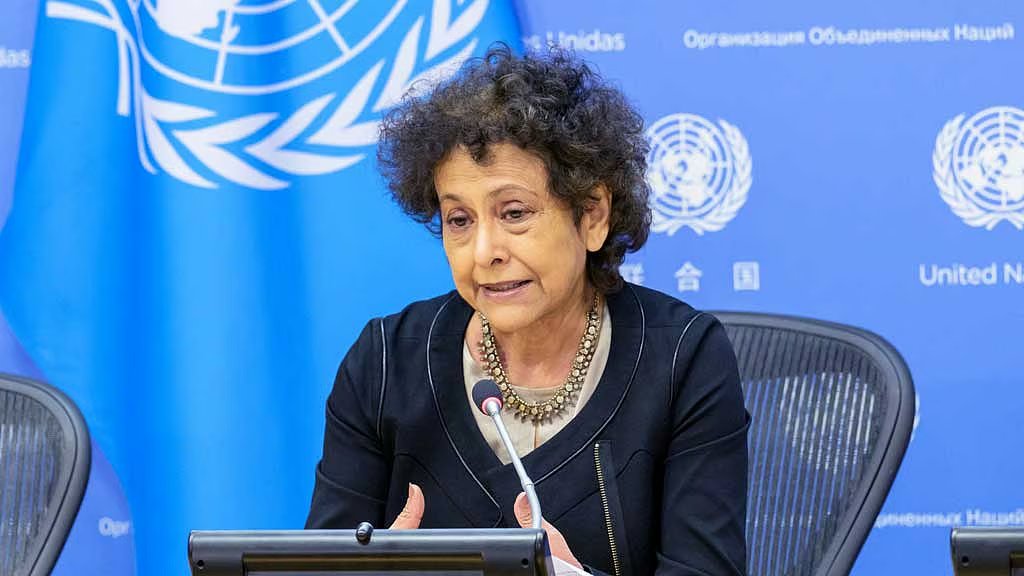
The government has appointed internationally renowned human rights advocate Irene Khan as Bangladesh’s permanent representative to the United Nations, granting her the rank of state minister.
The Cabinet Division issued a gazette notification on Wednesday confirming her contractual appointment.
According to the notification, Irene Khan will receive the rank, salary, allowances and other benefits of a state minister while serving as Bangladesh’s permanent representative and ambassador to the UN.
She will succeed Salahuddin Noman Chowdhury, the current permanent representative to Bangladesh’s UN Mission. Foreign ministry officials said Chowdhury is set to become the country’s next foreign secretary.
Khan has served as the UN Special Rapporteur on the promotion and protection of the right to freedom of opinion and expression since Aug 1, 2020, becoming the first woman to hold the mandate since it was established in 1993.
An internationally recognised advocate for human rights, gender equality and social justice, she also teaches at the Graduate Institute of International and Development Studies in Geneva.
She was secretary general of London-based Amnesty International from 2001 to 2009, becoming the first woman to lead the global human rights organisation. During her tenure, Amnesty expanded its work on economic, social and cultural rights alongside political and civil rights, and launched its first global campaign to end violence against women and girls.
From 2012 to 2019, Khan headed the International Development Law Organization (IDLO), an intergovernmental organisation dedicated to the rule of law and sustainable development.
She previously served as a visiting professor at the State University of New York Law School in 2011 and as chancellor of the University of Salford in the United Kingdom from 2009 to 2015.
Khan began her professional career with the UN High Commissioner for Refugees (UNHCR), where she worked for 21 years in headquarters and field operations, including as chief of mission in India.
She has also served on the World Bank Gender Advisory Council, the UNAIDS High Level Panel on HIV Prevention and Human Rights, and the UN Global Compact Advisory Council. She has been a governing board member of the Overseas Development Institute in the UK, BRAC and Uganda-based Barefoot Law.
Born in Bangladesh, Khan studied at University of Manchester and Harvard Law School. She has received several international honours, including the Sydney Peace Prize, for her contribution to human rights.
Bangladesh
Tarique outlines plan for employment exchange centres, expansion of overseas labour markets

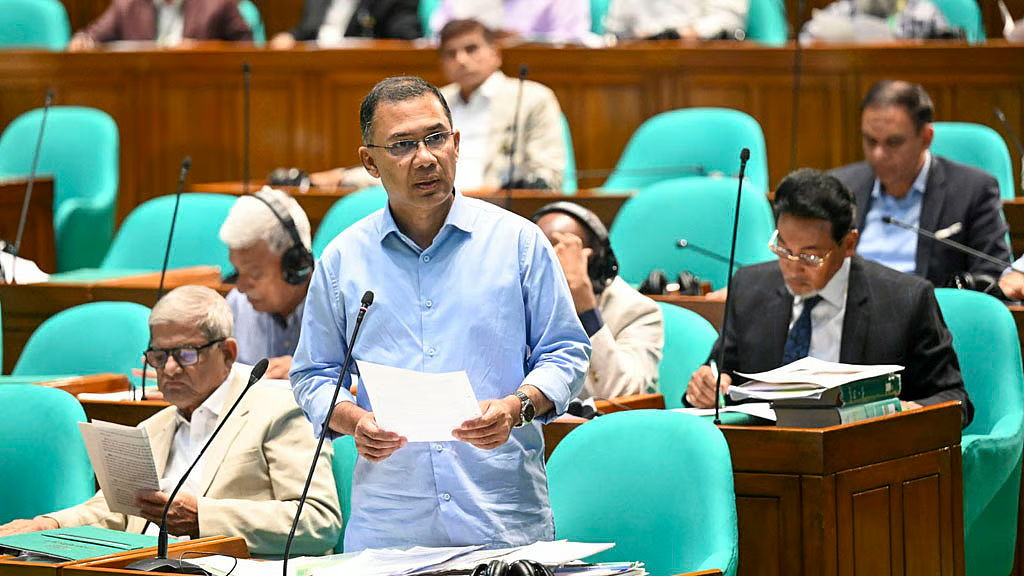
The government will establish Employment Exchange Centres across Bangladesh to strengthen domestic labour market management, improve skills development and expand job opportunities, Tarique Rahman has said.
Responding to a question from Tangail-6 MP Robiul Awal in parliament on Wednesday, the prime minister said the centres would be created in line with the government’s election manifesto.
He also said the government is working to reopen the Malaysian labour market, expand opportunities in Thailand, South Korea and Japan, and revive or widen labour markets in Oman, Bahrain and the United Arab Emirates through diplomatic efforts.
The government is also actively negotiating to set up visa centres in Dhaka for European nations like North Macedonia, Serbia, Mauritius, and Portugal to ease the migration process for skilled Bangladeshi workers, he said.
He added that the Bureau of Manpower, Employment and Training (BMET) will introduce more demand-driven language courses and increase the number of training institutions.
Bangladesh
Bangladesh extends curbs on govt-funded foreign travel, tightens rules on official vehicle purchases

The government has extended restrictions on government-funded overseas travel for public officials in the ongoing fiscal year and tightened rules on the purchase of official vehicles as part of efforts to reduce public expenditure.
The Finance Division issued a notification on Wednesday saying the measures are aimed at ensuring the proper use of limited public resources, bringing inflation to a tolerable level and maintaining macroeconomic stability.
Under the directive, government officials and employees will continue to be barred from attending seminars, symposiums and workshops abroad at government expense.
The notification also imposes stricter controls on the purchase of vehicles under both development and operational budgets.
Only vehicles included in the approved Table of Organisation and Equipment (TO&E) that are more than 10 years old may be replaced, it said.
New government institutions will require prior approval from the Finance Division before purchasing TO&E-listed vehicles.
The Finance Division also instructed all government agencies to suspend expenditure from all types of block allocations.
Funding for the purchase of all categories of vehicles, including motor vehicles, watercraft and aircraft, has also been halted.
However, vehicles used for transporting personnel rather than for personal use may be replaced if they are more than a decade old.
Newly established government institutions may also procure such vehicles only with Finance Division approval.
The notification also states that, except for ambulances and vehicles used for security purposes, all replacement or newly purchased government cars and jeeps must be fully electric.
The government said the measures are intended to curb operational spending while supporting broader efforts to maintain fiscal discipline and economic stability.

Two US soccer team staff members suspended by FIFA for Belgium World Cup game

Inside the Haaland machine

‘Little disappointed in our batting unit’: Miraz rues Tigers’ ODI opener defeat against Zimbabwe