Bangladesh
Bangladesh’s Press at a Crossroads: Between Promises of Reform and the Shadows of Repression


By Md Mojahidul Islam Dheow
Bangladesh’s press is at a crossroads. A year after the mass uprising of 2024 promised a fresh dawn for the country’s long-troubled media, journalists still move under a heavy cloud of political, institutional, and psychological pressure. Across the nation, more than 250 cases have been filed against reporters in the last 12 months—not all for crimes of substance. Some are clear attempts to stifle critical reporting; others stem from something as ordinary as a social media post. The message is unmistakable: those who challenge authority face serious consequences.
Legal reform has offered a glimmer of hope with the newly debated Section 173A of the CrPC, 1898, which allows an accused to be discharged during investigation if a high-ranking police supervisor finds insufficient evidence. But the question remains: will this tool be used impartially—or selectively, to shield the powerful and punish dissenters?
The dangers facing journalists were made starkly clear on August 7, when Asaduzzaman Tuhin was killed while on duty. Just a day earlier, Anwar Hossain was assaulted while reporting on extortion at a Gazipur CNG auto-rickshaw stand. These incidents are not isolated—they are part of a pattern of violence and intimidation aimed at silencing the press.
Even the newly crafted Cyber Security Ordinance (CSO) 2025—intended to replace repressive predecessors like the Digital Security Act (DSA) 2018 and the Cyber Security Act (CSA) 2023—retains troubling elements. While some contentious sections have been removed, Section 42 still allows the use of repressive tools drawn from the ICT Act 2006, the Evidence Act 1872, and the CrPC. Vague phrases such as “public confusion,” “threats to national security,” and “anti-state acts” remain undefined, enabling broad crackdowns on civil liberties, journalism, and political opposition.
Beyond the legal framework lies a deeper crisis. Corporate influence and editorial compromises have long weakened investigative journalism in Bangladesh. The media’s role as a pillar of democratic accountability has eroded, with many outlets beholden to owners’ political and commercial interests. With no substantial institutional reform since the change in government, the press remains vulnerable to regulatory harassment, licensing obstacles, and punitive taxation whenever coverage strays from the “approved” line.
Two proposed reform measures—the Journalists’ Protection Ordinance 2025 and the National Media Commission Ordinance 2025—once promising, are stalled in bureaucratic limbo. The “one house, one media” policy, intended to prevent individuals or organizations from owning multiple outlets, remains unrealized despite the Media Reform Commission’s advocacy.
Even the Bangladesh Press Council risks becoming yet another instrument of state control unless its mandate is reimagined to prioritize journalist protections. Political divisions within journalist unions and media organizations further weaken any unified stance for press freedom. Ownership patterns skew licensing and content toward vested interests, while dissenting voices are punished through regulatory harassment or punitive audits. Inside newsrooms, self-censorship grows as fear of legal trouble and professional retaliation suppresses candid reporting. Whistleblowers remain silent, and investigative journalism is increasingly replaced by risk-averse coverage.
What Bangladesh needs is a national framework for self-regulation that binds all outlets: an internal editorial code of conduct, a grievance redressal mechanism, anti-harassment policies, and straightforward complaint resolution processes. A transparent, independent media ombudsman should adjudicate defamation claims and public complaints. Only with genuine independence, accountability, and a clear commitment to journalist safety can the industry rebuild trust and integrity.
Beyond reform, there is an urgent need for immediate protection and practical empowerment of reporters in the field. The proposed Journalists’ Rights Protection Ordinance 2025 aims to codify such protections, with penalties of up to five years’ imprisonment and substantial fines for violence against journalists. It would:
(a) defend journalists from violence, threats, and harassment;
(b) shield sources and protect newsroom independence;
(c) guarantee the right to work without fear;
(d) ensure safe reporting environments within media organizations;
(e) safeguard good-faith reporting; and
(f) establish clear complaint, investigation, and trial procedures.
The ordinance mandates that fines can be directed as compensation to the harmed journalist and holds both individuals and, when applicable, organizations accountable for failing to prevent or address abuses.
If implemented effectively, it could mark a turning point. But enforcement requires a judiciary capable of handling cases efficiently and free from political influence. Authorities must be bound by law to protect journalists, safeguard newsroom neutrality, and defend those who publish information in the public interest.
The current moment is pivotal. Real reform demands more than laws on paper—it requires political courage, institutional independence, and a mature democratic culture. Journalists must unite beyond political divides, media owners must shed partisan agendas, and the state must commit to protecting the very people who hold it accountable.
Time is slipping away. Each delay erodes public trust, silences more journalists, and buries more truths. If Bangladesh is to have a democracy worthy of the name, it must build a press that is free, secure, and independent—not as an ornament of democracy, but as its beating heart.






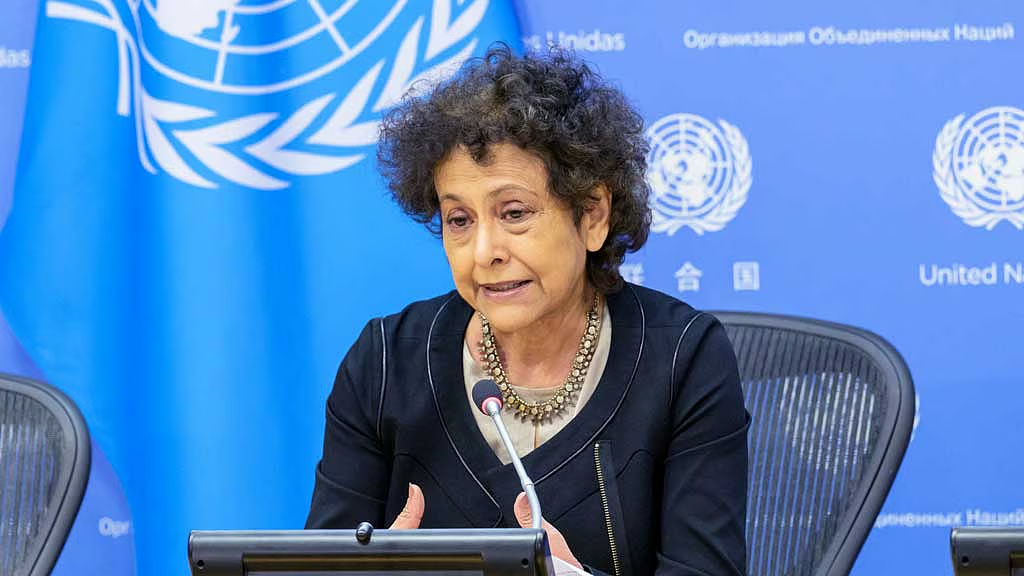
The government has appointed internationally renowned human rights advocate Irene Khan as Bangladesh’s permanent representative to the United Nations, granting her the rank of state minister.
The Cabinet Division issued a gazette notification on Wednesday confirming her contractual appointment.
According to the notification, Irene Khan will receive the rank, salary, allowances and other benefits of a state minister while serving as Bangladesh’s permanent representative and ambassador to the UN.
She will succeed Salahuddin Noman Chowdhury, the current permanent representative to Bangladesh’s UN Mission. Foreign ministry officials said Chowdhury is set to become the country’s next foreign secretary.
Khan has served as the UN Special Rapporteur on the promotion and protection of the right to freedom of opinion and expression since Aug 1, 2020, becoming the first woman to hold the mandate since it was established in 1993.
An internationally recognised advocate for human rights, gender equality and social justice, she also teaches at the Graduate Institute of International and Development Studies in Geneva.
She was secretary general of London-based Amnesty International from 2001 to 2009, becoming the first woman to lead the global human rights organisation. During her tenure, Amnesty expanded its work on economic, social and cultural rights alongside political and civil rights, and launched its first global campaign to end violence against women and girls.
From 2012 to 2019, Khan headed the International Development Law Organization (IDLO), an intergovernmental organisation dedicated to the rule of law and sustainable development.
She previously served as a visiting professor at the State University of New York Law School in 2011 and as chancellor of the University of Salford in the United Kingdom from 2009 to 2015.
Khan began her professional career with the UN High Commissioner for Refugees (UNHCR), where she worked for 21 years in headquarters and field operations, including as chief of mission in India.
She has also served on the World Bank Gender Advisory Council, the UNAIDS High Level Panel on HIV Prevention and Human Rights, and the UN Global Compact Advisory Council. She has been a governing board member of the Overseas Development Institute in the UK, BRAC and Uganda-based Barefoot Law.
Born in Bangladesh, Khan studied at University of Manchester and Harvard Law School. She has received several international honours, including the Sydney Peace Prize, for her contribution to human rights.
Bangladesh
Tarique outlines plan for employment exchange centres, expansion of overseas labour markets

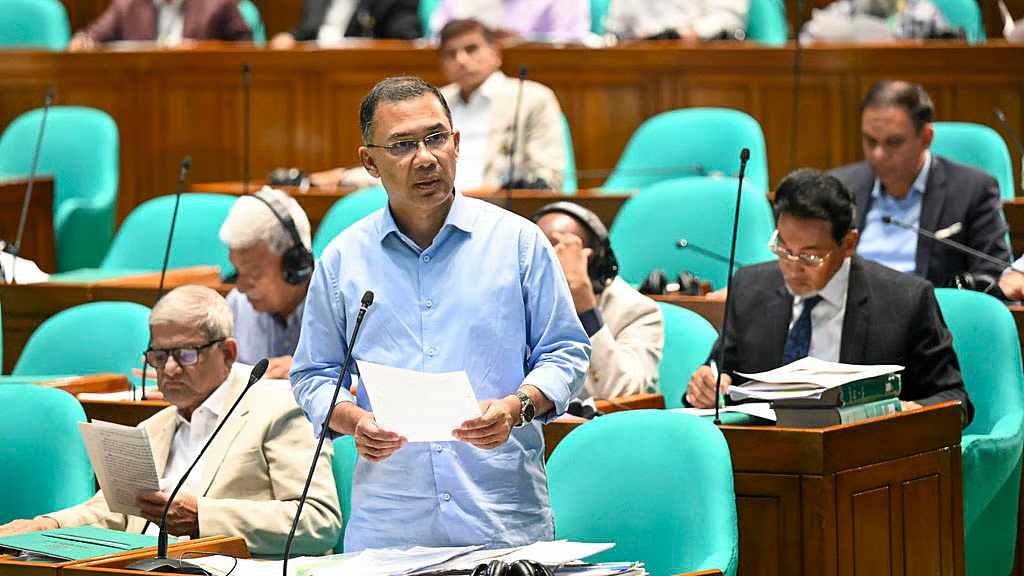
The government will establish Employment Exchange Centres across Bangladesh to strengthen domestic labour market management, improve skills development and expand job opportunities, Tarique Rahman has said.
Responding to a question from Tangail-6 MP Robiul Awal in parliament on Wednesday, the prime minister said the centres would be created in line with the government’s election manifesto.
He also said the government is working to reopen the Malaysian labour market, expand opportunities in Thailand, South Korea and Japan, and revive or widen labour markets in Oman, Bahrain and the United Arab Emirates through diplomatic efforts.
The government is also actively negotiating to set up visa centres in Dhaka for European nations like North Macedonia, Serbia, Mauritius, and Portugal to ease the migration process for skilled Bangladeshi workers, he said.
He added that the Bureau of Manpower, Employment and Training (BMET) will introduce more demand-driven language courses and increase the number of training institutions.
Bangladesh
Bangladesh extends curbs on govt-funded foreign travel, tightens rules on official vehicle purchases

The government has extended restrictions on government-funded overseas travel for public officials in the ongoing fiscal year and tightened rules on the purchase of official vehicles as part of efforts to reduce public expenditure.
The Finance Division issued a notification on Wednesday saying the measures are aimed at ensuring the proper use of limited public resources, bringing inflation to a tolerable level and maintaining macroeconomic stability.
Under the directive, government officials and employees will continue to be barred from attending seminars, symposiums and workshops abroad at government expense.
The notification also imposes stricter controls on the purchase of vehicles under both development and operational budgets.
Only vehicles included in the approved Table of Organisation and Equipment (TO&E) that are more than 10 years old may be replaced, it said.
New government institutions will require prior approval from the Finance Division before purchasing TO&E-listed vehicles.
The Finance Division also instructed all government agencies to suspend expenditure from all types of block allocations.
Funding for the purchase of all categories of vehicles, including motor vehicles, watercraft and aircraft, has also been halted.
However, vehicles used for transporting personnel rather than for personal use may be replaced if they are more than a decade old.
Newly established government institutions may also procure such vehicles only with Finance Division approval.
The notification also states that, except for ambulances and vehicles used for security purposes, all replacement or newly purchased government cars and jeeps must be fully electric.
The government said the measures are intended to curb operational spending while supporting broader efforts to maintain fiscal discipline and economic stability.

Two US soccer team staff members suspended by FIFA for Belgium World Cup game

Inside the Haaland machine

‘Little disappointed in our batting unit’: Miraz rues Tigers’ ODI opener defeat against Zimbabwe