Tech
Collision to remain in Toronto for 2024


Collision – one of the world’s biggest tech events, according to BNN Bloomberg – has confirmed today that it will host the 2024 event in Toronto. The event will bring together thousands of next-generation entrepreneurs, investors, and journalists from around the world.
This year, Collision is expected to contribute CA$49 million to Toronto’s economy, according to projections from Destination Toronto. Collision added CA$27 million to the city’s economy in 2019 and CA$43 million in 2022, resulting in a total economic impact of CA$188 million over three years.
In addition to the direct economic benefits, Collision provides an opportunity to showcase Canadian and Torontonian tech talent and companies to a global audience, while also positioning Toronto as a thriving and inclusive tech ecosystem in the long term. Google, Netflix, Reddit, Pinterest, Cloudflare and Snowflake have opened offices and engineering hubs in the region over the last four years, according to Toronto Global.
“We are delighted to be returning to Toronto in 2024. Despite the challenges posed by the Covid-19 pandemic and economic uncertainties in the tech industry, Collision has continued to flourish in this city. We are grateful for the support from Destination Toronto and the City of Toronto as we aim to make Collision even more globally impactful and to shine a spotlight on the remarkable Canadian and Toronto tech ecosystem on our global stage,” said Paddy Cosgrave, founder and CEO at Collision.
Collision 2023 will take place next week in Toronto, from June 26-29. It is projected to bring thousands of attendees – including major tech figures, such as godfather of AI Geoffrey Hinton, Conviction founder Sara Guo, AWS CEO Adam Selipsky and YouTube superstar Marques Brownlee – from more than 140 countries to the city.
More than 230 global partners – including Siemens, Volkswagen, AT&T, RBC, Google, AWS, Stripe and Salesforce – and thousands of startups will travel to Toronto next week from countries such as Nigeria, the Republic of Korea, Uruguay, Japan, Italy, Ghana and Pakistan, all taking to the event floor over three days.
Collision will also run programs and initiatives across the event that encourage a broad participation from communities in Canada, including thousands of students, members of Indigenous communities, and members of underrepresented groups in tech.
“I am so pleased that we will again welcome the Collision Conference to Toronto in 2024. This event puts our city on the global stage, showcasing our thriving technology community to industry leaders and major investors. It also significantly boosts our local economy: the 2022 conference generated $43 million in direct spending and $68 million in economic impact. I’m certain that this year’s conference, running from June 26 to 29, will be even more impactful for Toronto and the surrounding region” said Councillor Shelley Carroll (Don Valley North), Chair of the Economic and Community Development Committee
“Collision puts the spotlight on Toronto as the fastest-growing tech centre in North America. The city cultivates a distinctive mix of culture, education, diversity and talent for technology and innovation sectors to thrive. Hosting major events and conferences in Toronto, like Collision, delivers significant economic impact to our local economy and contributes to its vibrancy and appeal to residents and visitors. We look forward to welcoming start-ups, investors, governments, organizations and visitors from around the world to Toronto,” said Scott Beck, President & CEO, Destination Toronto
Canadian startups have experienced healthy VC activity despite the economic headwinds. According to PitchBook, for the first half of 2023, Canadian and Toronto startups surpassed 2019 and 2020 funding levels, beating pre-pandemic levels, with the value of deals in Toronto reaching US$1.3 billion. 2023 is up 120% compared to the first half of 2019 and 2020 (US$0.6 billion each year). Similarly, for Canadian startups, the deal value has increased by 40% from 2019 (563 deals at US$2.3 billion in Q1 and Q2) to 2023 (347 deals at US$3.2 billion).
















Apple , opens new tab plans to spend more than $30 billion under a multi-year chip supply deal with Broadcom, bolstering its U.S. sourcing as President Donald Trump’s administration pushes to expand domestic chip manufacturing.
Broadcom shares rose more than 4%, while Apple shares were down marginally.
Apple said on Wednesday the deal, which was struck earlier this week and runs through 2031, covers FBAR filters – or radio-frequency chips used for wireless connectivity in its devices – that it had been developing with Broadcom since at least 2023.
Broadcom will invest $1.5 billion to expand its Fort Collins, Colorado, factory under the deal, which Apple said would result in the production of at least 15 billion chips and support its work with the Trump administration to source more components domestically.
“The cutting-edge components built in Fort Collins are essential to delivering the incredible performance and connectivity our customers expect, and we’re proud to deepen our investments in U.S.-based suppliers that share our commitment to excellence and innovation,” Apple CEO Tim Cook said in a statement.
“We’re grateful to the president and his administration for supporting important projects like this.”
In August 2025, Apple raised its U.S. investment commitment to $600 billion over four years, adding $100 billion to a previously announced spending plan.

China is planning to allow the country’s top AI companies to buy a limited number of Nvidia’s, opens new tab H200 chips, the Information reported on Wednesday, citing two people with direct knowledge of the matter.
Chinese officials have told Alibaba, opens new tab, ByteDance and DeepSeek in recent weeks that they may soon receive permission to buy some H200 chips, the report said.
Shares of Nvidia rose 1% after the report.
The chip giant did not immediately respond to a Reuters request for comment, nor did the U.S. commerce department, which oversees exports of advanced AI chips overseas.
China’s commerce ministry also did not immediately respond to a request for comment, while Alibaba, ByteDance and DeepSeek did not respond outside of regular business hours.
The U.S. government has allowed Nvidia to sell its advanced H200 chips to China, and licensed about 10 Chinese firms to buy the chips. However, Chinese officials, keen to nurture domestic suppliers, have withheld approval so far.
Reuters reported in March that Nvidia had won Beijing’s approval to sell the chips to China, citing sources, and around the same time, Nvidia CEO Jensen Huang also told CNBC that the company had clearance from China.
Beijing is still determining the exact number of Nvidia chips to approve, and it could amount to fewer than 200,000 in total, the Information said, adding that was less than half of what the companies requested earlier this year.
Last month, Reuters exclusively reported that Nvidia told Chinese clients its new “Vera” central processors for AI data centres could be available as soon as August and that they can begin placing orders.
Nvidia’s market share in China has effectively fallen to zero, Huang said in October, hurt by U.S. export controls and Beijing’s push for self-reliance in key technologies.
The potential shift in China’s stance underscores the growing computing capacity crunch that the country’s tech companies are facing.
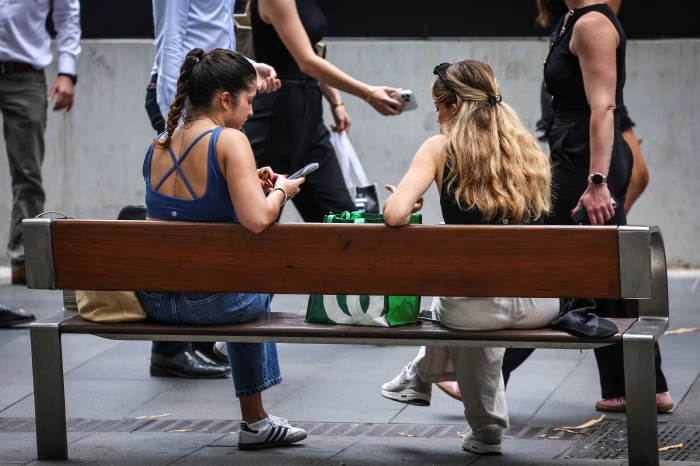
A team of software testers found that Australian social media platforms did not request age proof for any of 50 accounts that declared themselves to be 16, a result that leaves the country’s world-first under-16 ban “ineffective” at the most basic screening stage, according to a study seen by Reuters.
Since December, platforms such as Instagram, Snapchat and YouTube have been required to bar people under 16 and take “reasonable steps” to verify age, with regulators recommending multiple layered checks. But the new research, conducted by those who advised the nationwide curb, shows that the initial vetting step, which estimates a user’s age from general online activity, is failing to flag young people for tougher verification.
The testers, who last year trialled age-assurance software on more than 1,000 Australians, opened 50 new accounts after the law took effect and set the age as 16. None of the platforms asked for additional proof, the researchers told Reuters. The findings highlight a flaw that has been largely overlooked while public debate has focused on photo-based age-estimation tools.
The ban’s rollout has been widely criticised after surveys indicated that most under-16s still access the platforms. The government last month doubled the maximum fine and warned of possible court action against tech giants, accusing them of setting the system up to fail. Platforms have countered that they are simply following the regulator’s guidance, which prioritises low-friction checks and prevents reliance on government ID alone due to privacy concerns.
Some advisers to the original trial said they had repeatedly warned that the testing process ignored real-world circumvention, including minors entering false birthdates. “We did want to talk about circumvention, but we kept on being told that that wasn’t part of the actual trial,” Colm Gannon of the International Centre for Missing & Exploited Children told Reuters. A youth digital rights academic involved in a longer-term study of the ban said more impressive results might emerge once platforms move to age-inference methods later in the year. The regulator maintains that the recommended layered approach, if implemented correctly, ensures no single point of failure.

Two US soccer team staff members suspended by FIFA for Belgium World Cup game

Inside the Haaland machine

‘Little disappointed in our batting unit’: Miraz rues Tigers’ ODI opener defeat against Zimbabwe