Connect with us

Bangladesh

PM asks govt officials to ensure services for people

Published

on

Reading Time: 3 minutes

Prime Minister Sheikh Hasina today asked the government officials to ensure services for the people, saying Bangladesh became independent to change their fate.

“You (officials) should always keep in mind that people are never deprived of getting services because the independence of the country has been attained for changing their destiny,” she said.

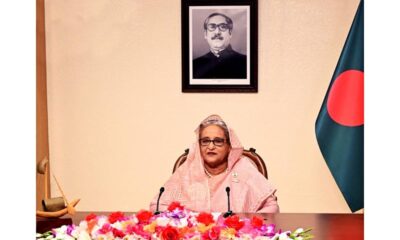
The premier said this while addressing the certificate distribution and closing ceremony of 121, 122 and 123 law and administration courses at BCS Administration Academy in the city’s Shahbag area.

She joined the function virtually from her official residence Ganabhaban here.

Advertisement

Sheikh Hasina directed the young officials of administration to always think about the people and know the area and livelihood of the people of the locality where they are posted for discharging duties.

“You (administration officials) have the highest opportunity to do the welfare of the people,” she said.

She also said the young officials of administration would get the opportunity to work in a realistic manner whenever they are posted in higher positions in future through the work experience in the field level.

The prime minister said that, “You will be the key to implementing Vision-2041 adopted by the government to turn Bangladesh into a developed country.”

With State Minister for Public Administration Farhad Hossain in the chair, BCS Administration Academy Rector Mominur Rashid Amin delivered the welcome address.

Advertisement

Chairman of the Parliamentary Standing Committee on the Ministry of Public Administration H N Ashequr Rahman and Senior Secretary of Public Administration Ministry KM Ali Azam also spoke.

An audio-visual documentary on BCS Administration Academy was screened.

On behalf of the prime minister, Farhad Hossain handed over the rector award, crests and certificates among the top positions recipients.

A total of 99 participants took part in the 121, 122 and 123 courses.

Three rector award recipients – Md Navid Rezwanul Kabir, Md Rakibul Hasan and Rezwana Afrin from 121, 122 and 123 courses respectively expressed their feelings.

Advertisement

Besides, Mahua Afroze and Alauddin of 121, Sabrina Sharmin and Suma Khatun of 122 and Kazi Md Anik Islam and Mehedi Hasan of 123 course secured second and third positions respectively.

The prime minister said that the trained and skilled civil service is one of the most associate tools to implement the commitment of her government.

“What we make commitments, the administration implements it,” she said, adding that, “We want you to pull the country ahead with your knowledge, merit and innovative skills, and serve the people.”

Referring to the second revolution taken by Father of the Nation Bangabandhu Sheikh Mujibur Rahman, the prime minister said if he could implement the activities of the second revolution, Bangladesh would have been established as a developed country in ten years.

But, Bangabandhu was not given this scope as he with most of his family members were assassinated brutally in 1975, she said.

Advertisement

She added, “After the killing of Bangabandhu on August 15, people of the country remained deprived and exploited.”

Mentioning that Bangabandhu gave directive to the public servants to always serve people, she said, “As a government official, I think that you should work to build the country with the spirit of War of Liberation, non-communal and developed Bangladesh”.

She said she wants the country to move forward.

After 21 years, she said Awami League assumed power in 1996 and in the five years, they increased the salary and facilities of government officials as well as continued endeavours to ensure the overall development and welfare of the countrymen.

Sheikh Hasina said the Father of the Nation had started rehabilitation of landless and homeless people, but it was not implemented after his assassination.

Advertisement

Following his footsteps, she said now her government has taken initiative to make sure that no people in the country will remain homeless and address-less.

In this connection, she referred to the Ashrayan-2 project which has been implemented since Awami League assumed power in the second term, as in the first tenure in 1996 they implemented Ashrayan-1 project.

She also extended her gratitude to the field level administration for successfully implementing the Ashrayan project, saying that, “there can be nothing more happiest moments than seeing the smiling faces of homeless people”.

Now, Bangladesh has become a developing nation fulfilling all criteria, she said.

“As a developing nation, we have to move forward further and make it stronger,” she added.

Advertisement

As a daughter of the Father of Nation, Sheikh Hasina said her government has to fulfill the basic rights of people and make Bangladesh a hunger-poverty-exploitation free developed country as dreamt by Bangabandhu.

“You, who are working in field-level administration, are the key to implementing the dream of the Father of the Nation,” she said.

Referring to the Constitution’s section-7 that stated “people are the owner of the country”, she said the goal of her government’s all activities is to ensure overall development of the people.

The prime minister said after 1975, who grabbed the power, they only took it as an enjoyment.

But, Sheikh Hasina said, “I am not only the prime minister, also a daughter of Bangabandhu. My responsibility is to ensure the basic rights of each people of the country and make development from grassroots.”

Advertisement

About the Perspective Plan-2041, she said they have framed a structure, which may be updated in necessity of time.

The country will forward on the basis of the plan through implementing short, medium and long term activities, she added.

Continue Reading
Advertisement

Bangladesh

Bangladesh’s Press at a Crossroads: Between Promises of Reform and the Shadows of Repression

Published

on

Reading Time: 3 minutes

By Md Mojahidul Islam Dheow

Bangladesh’s press is at a crossroads. A year after the mass uprising of 2024 promised a fresh dawn for the country’s long-troubled media, journalists still move under a heavy cloud of political, institutional, and psychological pressure. Across the nation, more than 250 cases have been filed against reporters in the last 12 months—not all for crimes of substance. Some are clear attempts to stifle critical reporting; others stem from something as ordinary as a social media post. The message is unmistakable: those who challenge authority face serious consequences.

Legal reform has offered a glimmer of hope with the newly debated Section 173A of the CrPC, 1898, which allows an accused to be discharged during investigation if a high-ranking police supervisor finds insufficient evidence. But the question remains: will this tool be used impartially—or selectively, to shield the powerful and punish dissenters?

The dangers facing journalists were made starkly clear on August 7, when Asaduzzaman Tuhin was killed while on duty. Just a day earlier, Anwar Hossain was assaulted while reporting on extortion at a Gazipur CNG auto-rickshaw stand. These incidents are not isolated—they are part of a pattern of violence and intimidation aimed at silencing the press.

Advertisement

Even the newly crafted Cyber Security Ordinance (CSO) 2025—intended to replace repressive predecessors like the Digital Security Act (DSA) 2018 and the Cyber Security Act (CSA) 2023—retains troubling elements. While some contentious sections have been removed, Section 42 still allows the use of repressive tools drawn from the ICT Act 2006, the Evidence Act 1872, and the CrPC. Vague phrases such as “public confusion,” “threats to national security,” and “anti-state acts” remain undefined, enabling broad crackdowns on civil liberties, journalism, and political opposition.

Beyond the legal framework lies a deeper crisis. Corporate influence and editorial compromises have long weakened investigative journalism in Bangladesh. The media’s role as a pillar of democratic accountability has eroded, with many outlets beholden to owners’ political and commercial interests. With no substantial institutional reform since the change in government, the press remains vulnerable to regulatory harassment, licensing obstacles, and punitive taxation whenever coverage strays from the “approved” line.

Two proposed reform measures—the Journalists’ Protection Ordinance 2025 and the National Media Commission Ordinance 2025—once promising, are stalled in bureaucratic limbo. The “one house, one media” policy, intended to prevent individuals or organizations from owning multiple outlets, remains unrealized despite the Media Reform Commission’s advocacy.

Even the Bangladesh Press Council risks becoming yet another instrument of state control unless its mandate is reimagined to prioritize journalist protections. Political divisions within journalist unions and media organizations further weaken any unified stance for press freedom. Ownership patterns skew licensing and content toward vested interests, while dissenting voices are punished through regulatory harassment or punitive audits. Inside newsrooms, self-censorship grows as fear of legal trouble and professional retaliation suppresses candid reporting. Whistleblowers remain silent, and investigative journalism is increasingly replaced by risk-averse coverage.

What Bangladesh needs is a national framework for self-regulation that binds all outlets: an internal editorial code of conduct, a grievance redressal mechanism, anti-harassment policies, and straightforward complaint resolution processes. A transparent, independent media ombudsman should adjudicate defamation claims and public complaints. Only with genuine independence, accountability, and a clear commitment to journalist safety can the industry rebuild trust and integrity.

Advertisement

Beyond reform, there is an urgent need for immediate protection and practical empowerment of reporters in the field. The proposed Journalists’ Rights Protection Ordinance 2025 aims to codify such protections, with penalties of up to five years’ imprisonment and substantial fines for violence against journalists. It would:
(a) defend journalists from violence, threats, and harassment;
(b) shield sources and protect newsroom independence;
(c) guarantee the right to work without fear;
(d) ensure safe reporting environments within media organizations;
(e) safeguard good-faith reporting; and
(f) establish clear complaint, investigation, and trial procedures.

The ordinance mandates that fines can be directed as compensation to the harmed journalist and holds both individuals and, when applicable, organizations accountable for failing to prevent or address abuses.

If implemented effectively, it could mark a turning point. But enforcement requires a judiciary capable of handling cases efficiently and free from political influence. Authorities must be bound by law to protect journalists, safeguard newsroom neutrality, and defend those who publish information in the public interest.

The current moment is pivotal. Real reform demands more than laws on paper—it requires political courage, institutional independence, and a mature democratic culture. Journalists must unite beyond political divides, media owners must shed partisan agendas, and the state must commit to protecting the very people who hold it accountable.

Time is slipping away. Each delay erodes public trust, silences more journalists, and buries more truths. If Bangladesh is to have a democracy worthy of the name, it must build a press that is free, secure, and independent—not as an ornament of democracy, but as its beating heart.

Advertisement

Continue Reading

Bangladesh

Investigation: Hasina’s ‘Shoot Directly’ Order and Its Deadly Consequences

Published

on

Reading Time: 2 minutes

On the morning of July 27, 2024, Sheikh Hasina stood silently at the podium of the National Institute of Traumatology and Orthopedic Rehabilitation (NITOR), commonly known as Pongu Hospital, in Dhaka.

For nearly 14 seconds during her eight-minute emotional speech, the former prime minister remained silent. A visible pain marked her face, reflecting the weight of the bloodshed that had occurred since July 16, when police forces fatally shot Abu Sayed in Rangpur with lethal weapons. That day, five more lives were lost amidst violence in Dhaka and Chattogram.

By the time Hasina addressed the crowd at NITOR, the death toll across the last two weeks had reached at least 162, many of whom had been shot with military-grade weapons by state security forces, according to The Daily Star’s investigations.

“I seek justice from my fellow citizens. What crimes have I committed to deserve this?” 77-year-old Hasina asked after visiting some of the injured at the hospital.

Advertisement

“I don’t want any mothers to lose their children like this. I’ve lost my parents; I know the pain… So many lives have been lost, so many families shattered. Who is responsible for all this?…” she began, but then, overcome with emotion, she left the stage in tears, unable to finish her words.

This heartfelt public address sharply contrasts with what was happening behind the scenes. An investigation by The Daily Star reveals that a state-sponsored machinery for mass violence had already been put into motion.

Just nine days earlier, on the evening of July 18, 2024, a phone rang inside the ousted prime minister’s residence, Gonobhaban, and Sheikh Hasina answered. On the line was Sheikh Fazle Noor Taposh, then the mayor of Dhaka South City. What followed was a startling disclosure of a lethal plan.

“We are now doing things differently. We are capturing photos with drones, and sending helicopters to several places,” Hasina told Taposh.

“Wherever they [the state forces] see gatherings, from the sky… I am getting it done from above, already started in several areas… already underway,” she said, while Taposh repeatedly pressed for launching a large-scale arrest campaign.

Advertisement

Continue Reading

Bangladesh

WB to provide $250m loan to modernise five public sector functions

Published

on

Reading Time: 2 minutes

The World Bank (WB) would provide US$250 million funds to facilitate improving transparency, accountability, and efficiency of some key government agencies in Bangladesh.
FE

The WB board on Saturday approved the loan to support the ongoing reform initiatives of the interim government, aimed at modernising crucial public sector functions.

These are essential for improving data transparency, domestic revenue mobilisation, public investment management, public procurement, and financial oversight, according to a statement issued on Saturday.

Under the Strengthening Institutions for Transparency and Accountability (SITA) project, five key government agencies – the Bangladesh Bureau of Statistics (BBS), the National Board of Revenue (NBR), the Planning Division, the Bangladesh Public Procurement Authority (BPPA), and the Office of the Comptroller and Auditor General (CAG) – would reform their operational activities.

Advertisement

The project is expected to streamline operations and improve service delivery within the five agencies and enhance access to reliable public statistics, crucial for transparent and accountable decision-making and policy formulation.

It will help modernise tax administration and increase tax compliance, thereby improving much-needed revenue mobilisation and fiscal sustainability.

The WB loan will also help improve the efficiency and accountability of public spending, ensuring that resources are utilised effectively for the benefit of all citizens.

It will develop a second generation of electronic government procurement (e-GP) and broaden its scope. The project will also help strengthen and digitise public audit.

Gayle Martin, the World Bank’s Interim Country Director for Bangladesh, on Saturday said: “The investment will leverage digitisation of business processes to help improve transparency and reduce corruption, by supporting Bangladesh in modernising public institutions capable of serving an emerging economy.”

Advertisement

This project will help improve the quality and accessibility of public services and thus enhance public trust in government institutions, she added.

According to the statement, the Bangladesh government and the WB are also preparing a development policy credit scheduled for the bank’s board discussion later this month.

Such credit is expected to support transparency and accountability in domestic revenue mobilisation, the banking sector, data production and dissemination.

Souleymane Coulibaly, World Bank Lead Country Economist and Task Team Leader for the project, said: “This project and the proposed development policy credit would be complementary and provide the government both the necessary hardware and software for improving public financial management and public service delivery.”

Advertisement
Continue Reading

Trending

Editor : Jashim Uddin ; Publisher: Rafiqul Alam Address: Bengal Centre (6th floor), 28 Topkhana Road, Dhaka-1000, Bangladesh Ph :+8802-7124586 e-mail:dailyfrontlinebd@gmail.com Copyright © 2020 Daily Frontline. Bangladesh Independent Daily.