Politics
PM urges not to instigate propaganda hindering constitutional process


Prime Minister Sheikh Hasina today called upon the pro-democratic and rule of law-believing political parties and organizations not to instigate the propaganda being hatched on the social media to hinder the country’s constitutional process.
“I am urging the political parties and organisations, believing in democracy and the rule of law, not to favour and provoke any weird idea that can impede the country’s constitutional process,” she said.
The premier also sought countrymen’s vigil so none can snatch away the people’s rights as she made a televised address to the nation marking the fourth year completion of Awami League (AL) government’s current tenure.
She asked all to remain alert as the anti-liberation forces, power grabbers, looters of people’s wealth and parasites are out to create instability to capture power from backdoor and impede democratic process while the national election will be held at the yearend or beginning of the next year.
“They have hired intellectuals and statement mongers at home and abroad in an attempt to mislead the people by giving false and fabricated information on social media. So, don’t be misled by their falsehood,” she said.
The prime minister hoped a free, fair and neutral election will be held, saying her government will provide all required cooperation to the Election Commission (EC) to this end.
She said her government has enacted a law for the first time to form an election commission through a search committee and gave the commission complete economic freedom to hold a free, fair election.
Sheikh Hasina, also President of the AL, said her party is pro-people and believes in people’s power, adding, “The AL will continue its noble duty of building the country if voted to power. Otherwise, we will stand in general people’s queue. But, we will continue to serve the people whatever our position is.”
The premier, as well, alerted all as none can create any anarchic situation and damage lives and properties of the masses in the name of movements.
She however termed the five years tenure of the BNP-Jamaat alliance government in Bangladesh’s history as ignominious as they assumed power through farcical election in 2001.
“The countrymen have never witnessed such misrule of the BNP-Jamaat alliance government establishing the culture of murder-disappearance, rape, looting, communalism and militancy that set a milestone,” she said.
After completion of the tenure, they tried to cling to power instead of handing over it peacefully and attempted to hold a farcical election with 1.23 crore fake voters, she said. “But they failed to do so due to the people’s uprising,” she added.
The AL assumed power after winning two-third seats in the national election held on December 29 in 2008, she continued.
Sheikh Hasina said the AL government has been running the country for 14 years in a row since 2009 after being elected through people’s mandate and the country has progressed much during the period.
She also described her government’s measures to ensure country’s development in every sector such as communication, education, health, investment, industrialisation, agriculture, generating employments and giving people the social protection.
“You (the people) will compare what we could give the country and its people for the last 14 years,” she said.
The prime minister said the people are now getting the benefit of her government’s long term plans referring to the “Vision 2021”, “Vision 2041” and “Delta Plan-2100”.
She said they have built “Digital Bangladesh” alongside achieving other targets including transformation of Bangladesh into a developing country in line with the “Vision 2021”.
“Our country has progressed a lot. But, we have to march further ahead. Our target is to achieve a developed and prosperous Bangladesh. Our next target is to build a ‘Smart Bangladesh’ after making a ‘Digital Bangladesh’,” she said.
She said her government has taken measures to prepare the youths with proper training as worthy for the fourth industrial revolution.
As part of the initiative of transforming Bangladesh into a “Smart Bangladesh”, she said her government is working to ensure use of robotics, official intelligence, nano-technology, genetic engineering and digital devices in making smart government, smart people, smart industries and business establishments, health, education, commerce and agriculture.
“Father of the Nation Bangabandhu Sheikh Mujibur Rahman wanted to build a “Sonar Bangla” free from exploitation and deprivation. Let’s to fulfil his dream by building a happy-prosperous and non-communal Bangladesh,” she said.
The premier went on saying that the target of the “Vision 2041” is to establish Bangladesh as a developed and prosperous country in the world map while the Delta Plan 2100 is aimed at ensuring Bangladesh’s sustainable growth.
“The image of Bangladesh has become brighter from brighter in the world for the last 14 years. No one considers Bangladesh as a country of flood, drought and disaster. Bangladesh is now a country of promising economy and role model for development,” she said.
Bangladesh has played a vital role in different international forums as it is an active member of over two dozens of the United Nations organisations and elected member of the UN Humanitarian Council for the fifth time, she said.
Sheikh Hasina said Bangladesh established an emblem ensuring peaceful co-existence with the neighbouring countries referring to enclave exchange with India implementing land boundary agreement and achieving rights on 118813 square kilometres of marine areas from India and Myanmar maintaining friendly relations.
“We have set a starry example of humanity at the globe by sheltering 11 lakh of Rohingyas,” she said.
The prime minister however greeted the countrymen at home and abroad on completion of the fourth year of her government’s current tenure and wished them Happy New Year.
Sheikh Hasina said they have made unimaginable development of Bangladesh including making the country self-reliant in food production, signing CHT Peace Treaty, Ganges Treaty, initiating the trial of the Bangabandhu killing case and jail killing case after rescinding the indemnity ordinance following getting the scope of running the state in 1996 after 21 years through people’s mandate.
The prime minister said her government assumed power for the second time in 2009 and since then they have been running the state for the last 14 years in a row.
In her address, she presented comparative statistics between the developments carried out by her government and the BNP-Jamaat alliance government and said where Bangladesh was 16 years back and what is its position now in the socio-economic indexes.
The per capita income, poverty rate, GDP growth, GDP size and budget was respectively 500 USD, 41.5 percent, 5.4 percent, 60 billion USD and TK 61,057 crore during the FY 2005-6 and now it stands at 2824 USD, 8.1 percent (before Corona virus pandemic) 460.75 billion USD and TK 6,78, 064 crore, she said.
The foreign currency reserve was 3 billion US Dollar in FY 2005-06 while it increased to 48 billion US Dollar in mid of 2021 and now it declined to 34 billion US Dollar due to increase of import expenses because of the global economic recession and increased inflation rate steaming from the Covid-19 pandemic and the Russia-Ukraine war, she said.
But, the current reserve is enough to meet import related expenses, she also said.
The power generation capacity in the last year of the BNP-Jamaat alliance was only 3,600 MW which is now increased to 25,826 MW , she said, adding that the AL government has reached electricity to every house.
She said a revolution has been made in the communication system in the last 14 years by building bridges on the major rivers including the Padma, Jamuna, Teesta, Payra, Meghna and Gomoti, constructing flyovers such as Hanif Flyover, Tejgaon-Moghbazar-Malibagh Flyover and Kamlapur-Shahjahanpur Flyover in Dhaka, Akhtaruzzaman Chowdhury Flyover and Bahadderhat Flyover in Chattogram, inaugurating Dhaka Metro Rail, aimed at building uninterrupted rail and road communications in the riverine Bangladesh.
The South Asia’s first underwater tunnel named “Bangabandhu Tunnel” in Chattogram will be opened soon while the work is progressing to complete the construction of country’s first nuclear power plant at Ishwardi in Pabna, she said, adding that Bangabandhu Satellite-1 was launched to the orbit in 2018.
She also mentioned that 100 bridges and 100 roads were opened in last November and December respectively, saying 718km highways have been made four lanes and above since 2009 to 2022 while 13,303 bridges were built or rebuilt and 21,267 metre culvert was constructed.
She added: “The greatest and largest achievements of the country including establishing an independent and sovereign Bangladesh have been attained at the hand of Bangladesh Awami League and the Awami League government,”.




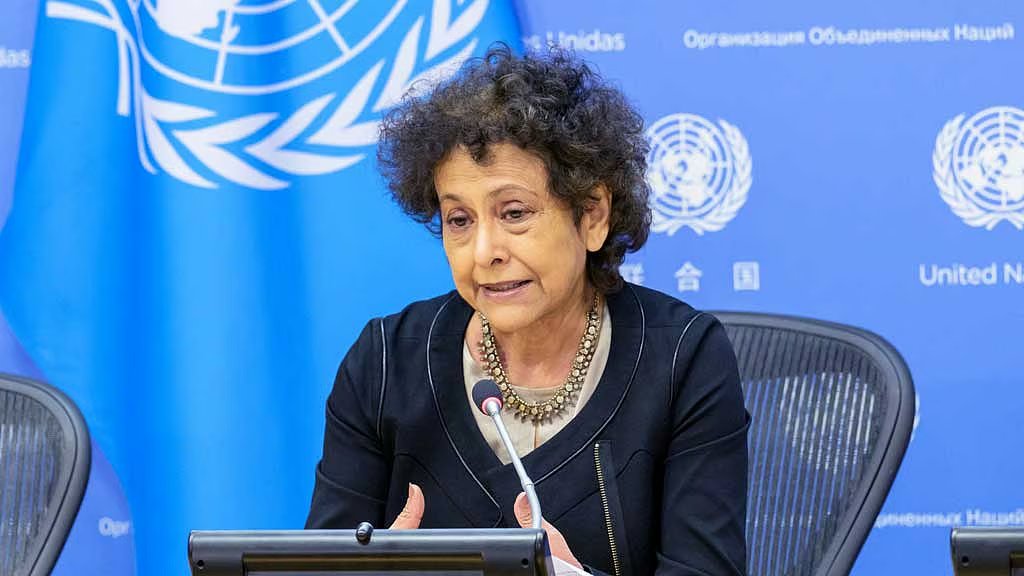
The government has appointed internationally renowned human rights advocate Irene Khan as Bangladesh’s permanent representative to the United Nations, granting her the rank of state minister.
The Cabinet Division issued a gazette notification on Wednesday confirming her contractual appointment.
According to the notification, Irene Khan will receive the rank, salary, allowances and other benefits of a state minister while serving as Bangladesh’s permanent representative and ambassador to the UN.
She will succeed Salahuddin Noman Chowdhury, the current permanent representative to Bangladesh’s UN Mission. Foreign ministry officials said Chowdhury is set to become the country’s next foreign secretary.
Khan has served as the UN Special Rapporteur on the promotion and protection of the right to freedom of opinion and expression since Aug 1, 2020, becoming the first woman to hold the mandate since it was established in 1993.
An internationally recognised advocate for human rights, gender equality and social justice, she also teaches at the Graduate Institute of International and Development Studies in Geneva.
She was secretary general of London-based Amnesty International from 2001 to 2009, becoming the first woman to lead the global human rights organisation. During her tenure, Amnesty expanded its work on economic, social and cultural rights alongside political and civil rights, and launched its first global campaign to end violence against women and girls.
From 2012 to 2019, Khan headed the International Development Law Organization (IDLO), an intergovernmental organisation dedicated to the rule of law and sustainable development.
She previously served as a visiting professor at the State University of New York Law School in 2011 and as chancellor of the University of Salford in the United Kingdom from 2009 to 2015.
Khan began her professional career with the UN High Commissioner for Refugees (UNHCR), where she worked for 21 years in headquarters and field operations, including as chief of mission in India.
She has also served on the World Bank Gender Advisory Council, the UNAIDS High Level Panel on HIV Prevention and Human Rights, and the UN Global Compact Advisory Council. She has been a governing board member of the Overseas Development Institute in the UK, BRAC and Uganda-based Barefoot Law.
Born in Bangladesh, Khan studied at University of Manchester and Harvard Law School. She has received several international honours, including the Sydney Peace Prize, for her contribution to human rights.
Bangladesh
Bangladesh extends curbs on govt-funded foreign travel, tightens rules on official vehicle purchases


The government has extended restrictions on government-funded overseas travel for public officials in the ongoing fiscal year and tightened rules on the purchase of official vehicles as part of efforts to reduce public expenditure.
The Finance Division issued a notification on Wednesday saying the measures are aimed at ensuring the proper use of limited public resources, bringing inflation to a tolerable level and maintaining macroeconomic stability.
Under the directive, government officials and employees will continue to be barred from attending seminars, symposiums and workshops abroad at government expense.
The notification also imposes stricter controls on the purchase of vehicles under both development and operational budgets.
Only vehicles included in the approved Table of Organisation and Equipment (TO&E) that are more than 10 years old may be replaced, it said.
New government institutions will require prior approval from the Finance Division before purchasing TO&E-listed vehicles.
The Finance Division also instructed all government agencies to suspend expenditure from all types of block allocations.
Funding for the purchase of all categories of vehicles, including motor vehicles, watercraft and aircraft, has also been halted.
However, vehicles used for transporting personnel rather than for personal use may be replaced if they are more than a decade old.
Newly established government institutions may also procure such vehicles only with Finance Division approval.
The notification also states that, except for ambulances and vehicles used for security purposes, all replacement or newly purchased government cars and jeeps must be fully electric.
The government said the measures are intended to curb operational spending while supporting broader efforts to maintain fiscal discipline and economic stability.
Environment
Sovereign guarantees limit renegotiation of private power plant contracts: power minister
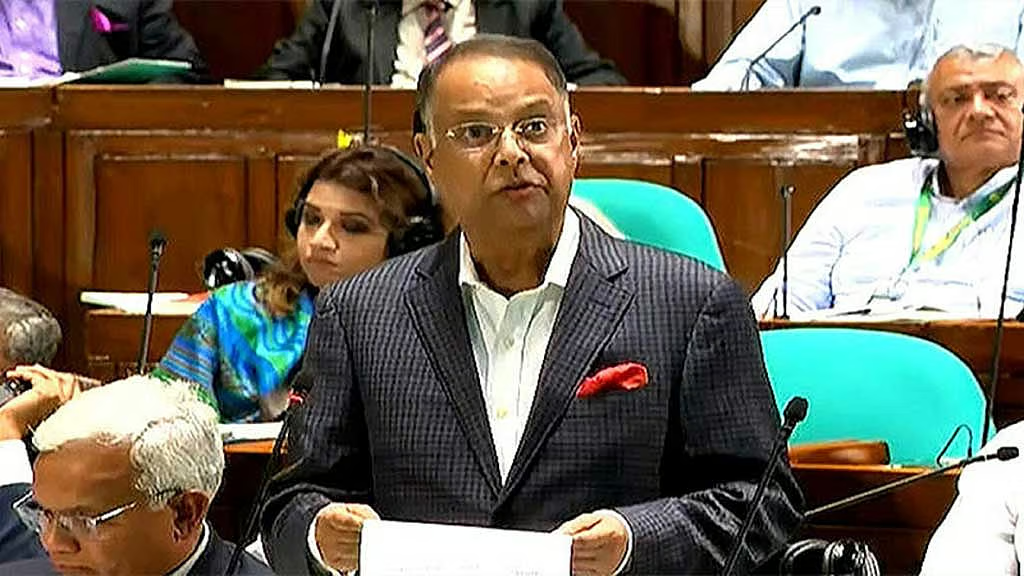
Power Minister Iqbal Hassan Mahmood has said the government’s ability to renegotiate costs, including capacity charges, under contracts signed with private power plants by the previous administration is limited because those agreements carry sovereign guarantees.
However, he told parliament on Wednesday that the government is negotiating with power producers to eliminate late payment fees on overdue bills.
The minister made the remarks while responding to a supplementary question from Jamaat lawmaker Mardia Mumtaz during the parliamentary session.
Mardia asked whether the government had a concrete plan to reduce capacity charges, which account for a significant share of electricity subsidies and overall power sector costs despite recent tariff increases.
In reply, Iqbal said the previous government had provided sovereign guarantees in contracts with private power companies.
“A sovereign guarantee is a guarantee by the state. Cancelling such guarantees requires a legal process that takes considerable time,” he said.

Two US soccer team staff members suspended by FIFA for Belgium World Cup game

Inside the Haaland machine

‘Little disappointed in our batting unit’: Miraz rues Tigers’ ODI opener defeat against Zimbabwe