Politics
Jatiya Party calls for all-party dialogue ahead of polls


Jatiya Party Chairperson GM Quader has called for an “all-party dialogue to ensure a free and fair polling” in Bangladesh.
He came up with the call in a telephonic interview with the Hindu.
In the interview, Quader created equidistance both from Prime Minister Hasina’s government as well as the BNP.
Quader said that it is very important for the government to come forward seeking a dialogue with all political parties.
“We want all sides should sit down and discuss a way out to ensure a free and fair election,” he said in the interview.
Quader, however, did not approve of the demand from BNP for a caretaker government.
The Jatiya Party leader said that they have been insisting for a caretaker government but have not clarified what exactly should the caretaker formation look like. He appeared to support a third alternative — a compromise formula — that can address the hard positions.
He told the Hindu: “We have a formula in mind and we will place it on the table when an all-party dialogue takes place.”
Days after hosting a high-level delegation from the ruling Awami League, India has broadened engagement with the political spectrum of Dhaka and has invited a team from the Jatiya Party led by Chairperson GM Quader, reports the Hindu.
The arrival of the Jatiya Party’s team is significant as India plans to host Prime Minister Sheikh Hasina at the G-20 summit where Bangladesh has been invited as a “guest country”.
The visit adds to the ongoing exchanges involving multiple comments from the US and Indian interlocutors over the past fortnight.
Last week, two US Congressmen Rich McCormick and Ed Case visited Bangladesh and met with Foreign Minister AK Abdul Momen as well as representatives of the BNP and Jatiya Party.
“Of the two congressmen, the senior one clearly told us that they want to see such an election which will be held in a neutral and democratic manner and the world will regard that as free and fair,” a Jatiya party leader told the media after the meeting.
Both Congressmen were hosted at the Observer Research Foundation (ORF) in Delhi on August 17 where they attended a “closed-door discussion”.
A day prior, ORF held a meeting with Clifford Smith, Washington Project Director, Middle East Forum, USA, where he hinted at the difficulty that the US is facing in making up its mind regarding the evolving situation in Bangladesh.
Smith presented a detailed account of the Bangladesh Jamaat-e-Islami’s activities in the Bangladesh diaspora in the US and said that at one point, the student wing of Jamaat was “the most violent in the world”.
Smith, however, pointed out that Hasina’s anti-terror outfit, RAB has not done enough to crack down on the religious fundamentalists. These remarks from the US were met with reiteration of the mainstream Indian position by Joint Secretary at Bangladesh and Myanmar Division of the Ministry of External Affairs Smita Pant.
On August 15, she paid tribute to the memories of Bangabandhu Sheikh Mujibur Rahman and said: “Killers of Sheikh Mujib could not wipe out his ideas.”
On Saturday, Indian High Commissioner to Dhaka Pranay Verma paid his tribute to Sheikh Mujib and said India is a “steadfast partner” of Bangladesh.
The ongoing exchanges are clearly broadening with the arrival of Jatiya Party in Delhi with some Dhaka sources indicating that similar “windows” are also open at other relevant quarters.
Apart from these, the government-to-government discussion will deepen as both Indian Prime Minister Narendra Modi and PM Hasina will fly to Johannesburg for the BRICS summit where Bangladesh is among several economies that are seeking BRICS membership.


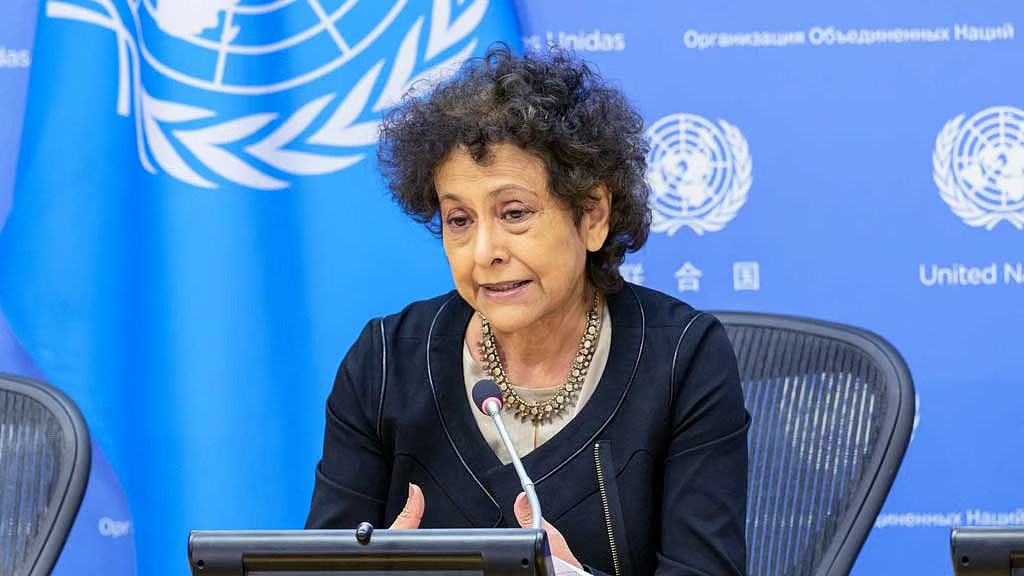
The government has appointed internationally renowned human rights advocate Irene Khan as Bangladesh’s permanent representative to the United Nations, granting her the rank of state minister.
The Cabinet Division issued a gazette notification on Wednesday confirming her contractual appointment.
According to the notification, Irene Khan will receive the rank, salary, allowances and other benefits of a state minister while serving as Bangladesh’s permanent representative and ambassador to the UN.
She will succeed Salahuddin Noman Chowdhury, the current permanent representative to Bangladesh’s UN Mission. Foreign ministry officials said Chowdhury is set to become the country’s next foreign secretary.
Khan has served as the UN Special Rapporteur on the promotion and protection of the right to freedom of opinion and expression since Aug 1, 2020, becoming the first woman to hold the mandate since it was established in 1993.
An internationally recognised advocate for human rights, gender equality and social justice, she also teaches at the Graduate Institute of International and Development Studies in Geneva.
She was secretary general of London-based Amnesty International from 2001 to 2009, becoming the first woman to lead the global human rights organisation. During her tenure, Amnesty expanded its work on economic, social and cultural rights alongside political and civil rights, and launched its first global campaign to end violence against women and girls.
From 2012 to 2019, Khan headed the International Development Law Organization (IDLO), an intergovernmental organisation dedicated to the rule of law and sustainable development.
She previously served as a visiting professor at the State University of New York Law School in 2011 and as chancellor of the University of Salford in the United Kingdom from 2009 to 2015.
Khan began her professional career with the UN High Commissioner for Refugees (UNHCR), where she worked for 21 years in headquarters and field operations, including as chief of mission in India.
She has also served on the World Bank Gender Advisory Council, the UNAIDS High Level Panel on HIV Prevention and Human Rights, and the UN Global Compact Advisory Council. She has been a governing board member of the Overseas Development Institute in the UK, BRAC and Uganda-based Barefoot Law.
Born in Bangladesh, Khan studied at University of Manchester and Harvard Law School. She has received several international honours, including the Sydney Peace Prize, for her contribution to human rights.
Bangladesh
Bangladesh extends curbs on govt-funded foreign travel, tightens rules on official vehicle purchases

The government has extended restrictions on government-funded overseas travel for public officials in the ongoing fiscal year and tightened rules on the purchase of official vehicles as part of efforts to reduce public expenditure.
The Finance Division issued a notification on Wednesday saying the measures are aimed at ensuring the proper use of limited public resources, bringing inflation to a tolerable level and maintaining macroeconomic stability.
Under the directive, government officials and employees will continue to be barred from attending seminars, symposiums and workshops abroad at government expense.
The notification also imposes stricter controls on the purchase of vehicles under both development and operational budgets.
Only vehicles included in the approved Table of Organisation and Equipment (TO&E) that are more than 10 years old may be replaced, it said.
New government institutions will require prior approval from the Finance Division before purchasing TO&E-listed vehicles.
The Finance Division also instructed all government agencies to suspend expenditure from all types of block allocations.
Funding for the purchase of all categories of vehicles, including motor vehicles, watercraft and aircraft, has also been halted.
However, vehicles used for transporting personnel rather than for personal use may be replaced if they are more than a decade old.
Newly established government institutions may also procure such vehicles only with Finance Division approval.
The notification also states that, except for ambulances and vehicles used for security purposes, all replacement or newly purchased government cars and jeeps must be fully electric.
The government said the measures are intended to curb operational spending while supporting broader efforts to maintain fiscal discipline and economic stability.
Environment
Sovereign guarantees limit renegotiation of private power plant contracts: power minister
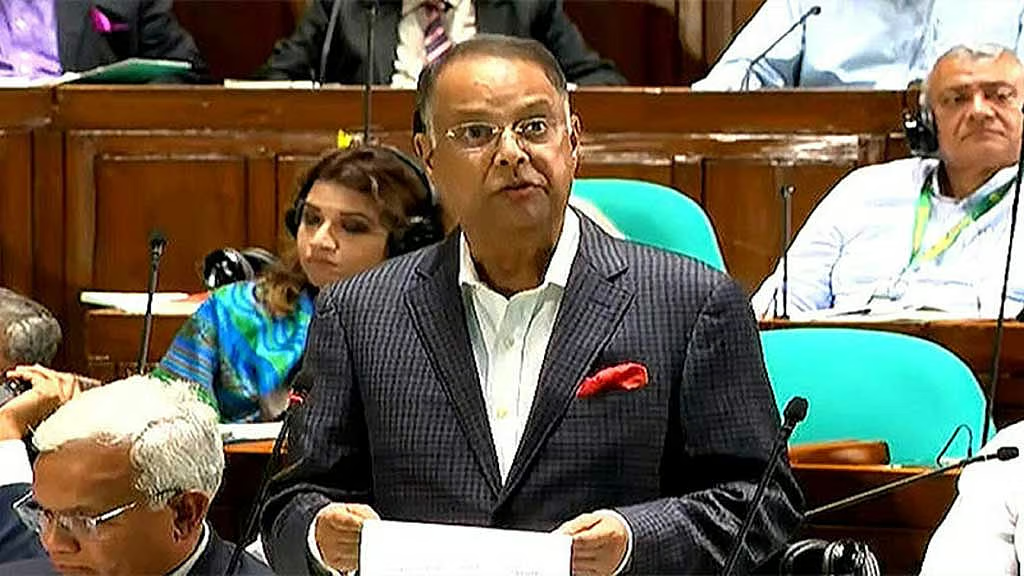
Power Minister Iqbal Hassan Mahmood has said the government’s ability to renegotiate costs, including capacity charges, under contracts signed with private power plants by the previous administration is limited because those agreements carry sovereign guarantees.
However, he told parliament on Wednesday that the government is negotiating with power producers to eliminate late payment fees on overdue bills.
The minister made the remarks while responding to a supplementary question from Jamaat lawmaker Mardia Mumtaz during the parliamentary session.
Mardia asked whether the government had a concrete plan to reduce capacity charges, which account for a significant share of electricity subsidies and overall power sector costs despite recent tariff increases.
In reply, Iqbal said the previous government had provided sovereign guarantees in contracts with private power companies.
“A sovereign guarantee is a guarantee by the state. Cancelling such guarantees requires a legal process that takes considerable time,” he said.

Two US soccer team staff members suspended by FIFA for Belgium World Cup game

Inside the Haaland machine

‘Little disappointed in our batting unit’: Miraz rues Tigers’ ODI opener defeat against Zimbabwe