Politics
Malaysia labour market reopens for Bangladeshis

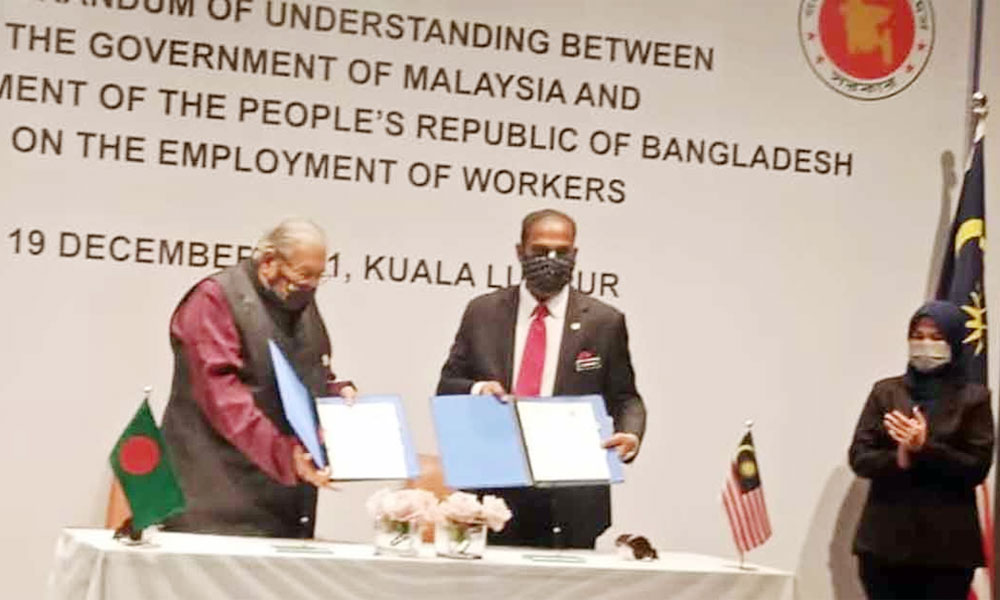
After a hiatus of over three years, Malaysia has officially reopened its labour market to Bangladeshi workers for five years until December 2026.
To meet the growing demand of workers following the Covid-19 pandemic, the Southeast Asian country has started hiring workers from potential countries, and as part of the move, the Malaysian cabinet on 10 December decided to resume the recruitment of Bangladeshi workers.
Expatriates’ Welfare Minister Imran Ahmed and Malaysian Minister for Human Resources, Seri Saravanan Murugan, signed a memorandum of understanding (MoU) in this regard at 11am Sunday in Malaysia.
Under the new deal, Malaysian employers will bear all costs of Bangladeshi workers, including immigration fee, visa fee, health examination cost, insurance cost, Covid-19 test cost and quarantine related cost, read a press release from the expatriate welfare ministry.
Besides, employers can hire Malaysian recruiting agents at their own expense and they will be responsible for ensuring quality accommodation, medical care, and the welfare of workers, it added.
Earlier on Sunday, a four-member team led by minister Imran reached Kuala Lumpur to sign the deal.
After signing the deal, Malaysian minister Saravanan, in a statement said, “The inking of the MoU is expected to meet the urgent need for foreign workers.”
He also said the MoU outlined the responsibilities of both countries, including those related to employers from Malaysia and workers from Bangladesh, as well as the duties of private employment agencies in both countries, reports Bernama, the national news agency of Malaysia.
“The implementation of the MoU would be regulated by a Joint Working Group (JWG) with members from both countries,” added the minister.
The new deal has opened the recruitment of Bangladeshi workers in all sectors including plantations, agriculture, manufacturing, services, mining, construction, and household services.
Expatriates’ Welfare and Overseas Employment Secretary Dr Ahmed Munirus Saleheen, Bangladesh’s High Commissioner to Malaysia, Md Golam Sarwar, Director General of Bureau of Manpower Employment and Training (BMET) Md Shahidul Alam, and Deputy Secretary-General of the Ministry of Human Resources of Malaysia, Datu Muhammad Khair Ajman bin Mohammed Anwar, were also present at the signing ceremony.
According to the MoU, the employers will select Bangladeshi agents in accordance with the rules of the Malaysian government from the list of legitimate recruitment agencies sent by Bangladesh. The MoU further states that the Malaysian government will ensure transparency and fairness in this regard.
The recruitment process of new workers is expected to begin soon after the necessary formalities are completed.
According to the ministry press statement, both countries acknowledged on the occasion that Bangladeshi workers are contributing to the economic development of Malaysia as well as to the development of Bangladesh.
The agreement has further protected the rights and dignity of workers in accordance with the laws, rules, regulations, national policies and guidelines of both countries, it added.
Abul Bashar, former president of Bangladesh Association of International Recruiting Agencies (Baira) told TBS, “Under the new MoU, migration costs would not cross the range between Tk80,000 to Tk1.20 lakh. If employers bear air tickets, the cost would further decrease. The migration cost used to be around Tk4-4.5 lakh.”
He also said that before closing the market, around 10-15 thousand workers went to Malaysia each month.
“Now, some 20-30 thousand workers will migrate to Malaysia in the coming months as employers there need a large number of foreign workers,” he said.
Malaysia is home to around eight lakh Bangladeshis, according to an unofficial estimate.
The country suspended hiring Bangladeshi workers in September 2018 over allegations of malpractice in the recruitment process and high recruitment costs.
Mohammad Rasheduzzaman, assistant personal secretary to the expat minister, told TBS, “There is no decision yet on how many recruiting agencies will send workers.”
Commenting on recruiting agency syndicates, the Expat minister on Friday said, “I am not in favour of any syndicate to send workers to Malaysia. We want to send workers in a process where all recruiting agencies can participate, not some particular agencies.”
In line with the decision of the Malaysian cabinet meeting on 10 December, the Malaysian minister said on Sunday that the standard operating procedures (SOP) for the entry of foreign workers had been fine-tuned and improved.
He said the SOP covered four phases, namely pre-release, upon arrival, after arrival (quarantine) and post-quarantine.


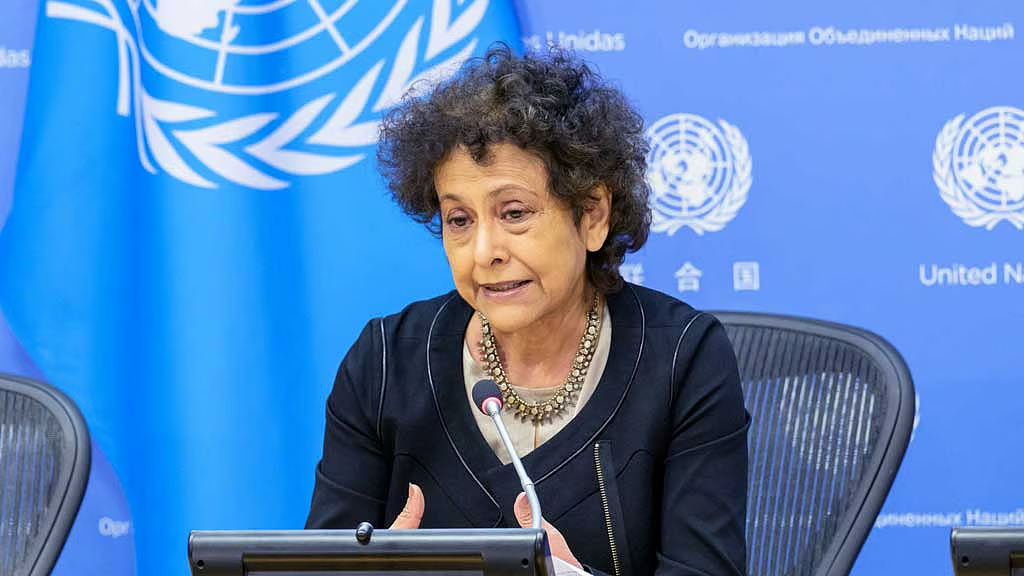
The government has appointed internationally renowned human rights advocate Irene Khan as Bangladesh’s permanent representative to the United Nations, granting her the rank of state minister.
The Cabinet Division issued a gazette notification on Wednesday confirming her contractual appointment.
According to the notification, Irene Khan will receive the rank, salary, allowances and other benefits of a state minister while serving as Bangladesh’s permanent representative and ambassador to the UN.
She will succeed Salahuddin Noman Chowdhury, the current permanent representative to Bangladesh’s UN Mission. Foreign ministry officials said Chowdhury is set to become the country’s next foreign secretary.
Khan has served as the UN Special Rapporteur on the promotion and protection of the right to freedom of opinion and expression since Aug 1, 2020, becoming the first woman to hold the mandate since it was established in 1993.
An internationally recognised advocate for human rights, gender equality and social justice, she also teaches at the Graduate Institute of International and Development Studies in Geneva.
She was secretary general of London-based Amnesty International from 2001 to 2009, becoming the first woman to lead the global human rights organisation. During her tenure, Amnesty expanded its work on economic, social and cultural rights alongside political and civil rights, and launched its first global campaign to end violence against women and girls.
From 2012 to 2019, Khan headed the International Development Law Organization (IDLO), an intergovernmental organisation dedicated to the rule of law and sustainable development.
She previously served as a visiting professor at the State University of New York Law School in 2011 and as chancellor of the University of Salford in the United Kingdom from 2009 to 2015.
Khan began her professional career with the UN High Commissioner for Refugees (UNHCR), where she worked for 21 years in headquarters and field operations, including as chief of mission in India.
She has also served on the World Bank Gender Advisory Council, the UNAIDS High Level Panel on HIV Prevention and Human Rights, and the UN Global Compact Advisory Council. She has been a governing board member of the Overseas Development Institute in the UK, BRAC and Uganda-based Barefoot Law.
Born in Bangladesh, Khan studied at University of Manchester and Harvard Law School. She has received several international honours, including the Sydney Peace Prize, for her contribution to human rights.
Bangladesh
Bangladesh extends curbs on govt-funded foreign travel, tightens rules on official vehicle purchases

The government has extended restrictions on government-funded overseas travel for public officials in the ongoing fiscal year and tightened rules on the purchase of official vehicles as part of efforts to reduce public expenditure.
The Finance Division issued a notification on Wednesday saying the measures are aimed at ensuring the proper use of limited public resources, bringing inflation to a tolerable level and maintaining macroeconomic stability.
Under the directive, government officials and employees will continue to be barred from attending seminars, symposiums and workshops abroad at government expense.
The notification also imposes stricter controls on the purchase of vehicles under both development and operational budgets.
Only vehicles included in the approved Table of Organisation and Equipment (TO&E) that are more than 10 years old may be replaced, it said.
New government institutions will require prior approval from the Finance Division before purchasing TO&E-listed vehicles.
The Finance Division also instructed all government agencies to suspend expenditure from all types of block allocations.
Funding for the purchase of all categories of vehicles, including motor vehicles, watercraft and aircraft, has also been halted.
However, vehicles used for transporting personnel rather than for personal use may be replaced if they are more than a decade old.
Newly established government institutions may also procure such vehicles only with Finance Division approval.
The notification also states that, except for ambulances and vehicles used for security purposes, all replacement or newly purchased government cars and jeeps must be fully electric.
The government said the measures are intended to curb operational spending while supporting broader efforts to maintain fiscal discipline and economic stability.
Environment
Sovereign guarantees limit renegotiation of private power plant contracts: power minister
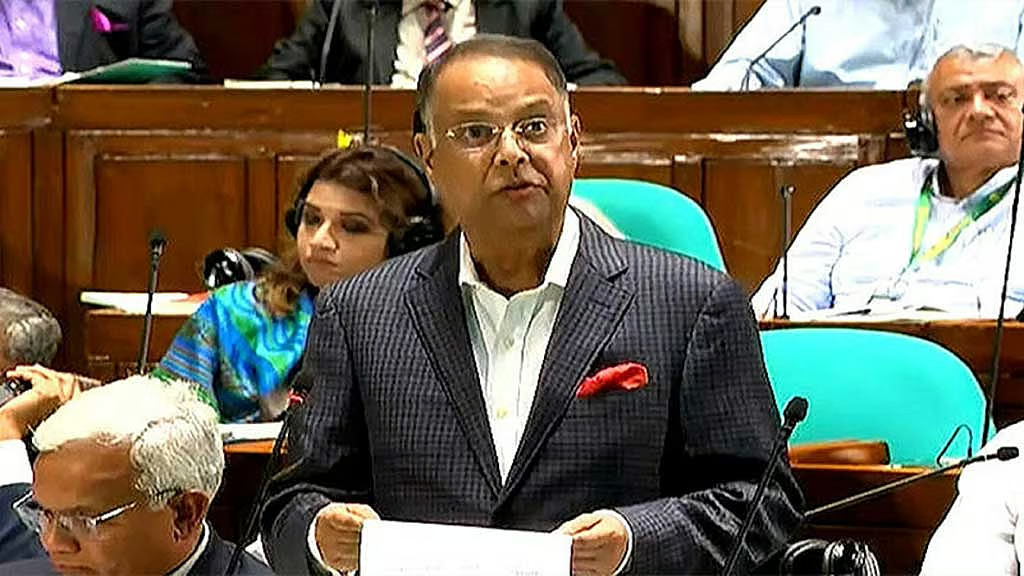
Power Minister Iqbal Hassan Mahmood has said the government’s ability to renegotiate costs, including capacity charges, under contracts signed with private power plants by the previous administration is limited because those agreements carry sovereign guarantees.
However, he told parliament on Wednesday that the government is negotiating with power producers to eliminate late payment fees on overdue bills.
The minister made the remarks while responding to a supplementary question from Jamaat lawmaker Mardia Mumtaz during the parliamentary session.
Mardia asked whether the government had a concrete plan to reduce capacity charges, which account for a significant share of electricity subsidies and overall power sector costs despite recent tariff increases.
In reply, Iqbal said the previous government had provided sovereign guarantees in contracts with private power companies.
“A sovereign guarantee is a guarantee by the state. Cancelling such guarantees requires a legal process that takes considerable time,” he said.

Two US soccer team staff members suspended by FIFA for Belgium World Cup game

Inside the Haaland machine

‘Little disappointed in our batting unit’: Miraz rues Tigers’ ODI opener defeat against Zimbabwe