Business
‘Vision 2041’ to be implemented through Public-Private Partnership


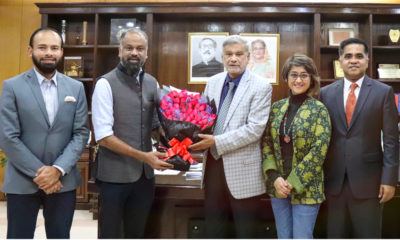
Bangladesh government’s Information and Communication Technology (ICT) Division and Bangladesh Association of Software and Information Services (BASIS) will work together to implement ‘Vision 2041’ of Bangladesh through expanding its presence in the local and international market, industry branding, policy support and ensuring business-friendly environment. ICT State Minister Zunaid Ahmed Palak and BASIS President Russell T. Ahmed jointly expressed their consent in this regard in a meeting of ICT Division and BASIS Executive Council on Sunday at Agargaon’s ICT Tower.
ICT State Minister Zunaid Ahmed Palak said, “In just 13 years, through the farsightedness of Honorable Prime Minister Sheikh Hasina, Bangladesh has become a technology-based least developed country. BASIS contributed greatly in this regard and the government created the opportunity through policy support. The declaration of ICT as Product of the year has given the sector a special importance. To make use of this opportunity, we will work with BASIS in five areas: development of skilled labor; policy formulation and reform; technology and invention; foreign direct investment harnessing; and international plus local market development.” He added, “We will request the Honorable Finance Minister to increase the period of corporate tax exemption till 2030. Already, in coordination with ICT Division and BASIS, different working groups have been created to implement the activities of different areas. These initiatives will help us implement ‘Vision 2041’. From Digital Bangladesh, Bangabandhu’s Golden Bangladesh will transform into ‘Innovative Bangladesh’.”
BASIS President Russell T. Ahmed said, “Honorable Prime Minister Sheikh Hasina, Honorable ICT Advisor to Prime Minister Sajeeb Wazed Joy and Honorable ICT State Minister Zunaid Ahmed Palak have given the ICT sector of Bangladesh so much importance that they take initiatives for this sector before we even ask for those. Prime Minister declared ICT as the product of the year and the government is working to implement ‘Vision 2041’. There is a target to earn US$ 5 billion in exports from ICT sector by 2025. BASIS will have a great role in this regard. It is a great chance and opportunity for us as well as our responsibility. We will work together with the government to fulfill the responsibilities and work towards implementing ‘Vision 2041’.”
ICT Division Senior Secretary N M Zeaul Alam PAA, Director General of Digital Security Agency and Additional Secretary Md. Khairul Amin, Managing Director of Bangladesh Hi-Tech Park Authority and Additional Secretary Bikarna Kumar Ghosh, Managing Director of Bangladesh Data Center Company Limited Abu Sayeed Chowdhury, A2I Project Director Dr. Dewan Muhammad Humayun Kabir, EDGE Project Director and Joint Secretary Dr. Muhammed Mehedi Hassan, Director General of the Department of Information and Communication Technology and Joint Secretary Md. Rezaul Maksud Jahedi, BASIS Senior Vice President Samira Zuberi Himika, BASIS Vice President (Administration) Abu Daud Khan, BASIS Vice President (Finance) Fahim Ahmed, BASIS Directors- Ahmedul Islam Babu, Mushfiqur Rahman, Tanvir Hossain Khan, Mostafizur Rahman Sohel and Rashad Kabir were present at the meeting.












The European Union’s General Court on Wednesday dismissed appeals lodged by Irish low-cost airline Ryanair against an Italian state aid scheme approved to support airlines during the COVID pandemic.
The court ruled that the aid scheme consisting of subsidies paid by Italy to airlines affected by the COVID-19 crisis “was compliant with EU law”, insofar as it did not breach the principle of non-discrimination, nor the principles of freedom to provide services and the freedom of establishment.
The budget airline had brought the case as it sought to annul a 2020 aid scheme set up by Italy to support airlines licensed in the country with a €130 million fund, which was later increased by €100 million.
The scheme was approved by the European Commission, the European authority vetting member states’ aid programs.
Ryanair alleged the aid was discriminatory and that the approval by the European Commission breached procedural rules.
The General Court initially struck down the Commission decision in 2023, although the top European tribunal, the Court of Justice, referred the case back to the General Court in 2025.
Back in April of this year, Ryanair won in another similar case in the EU’s Court of Justice against German state aid to its main airline Lufthansa during COVID.

Bangladesh has a strict anti-money laundering framework, but implementation remains uneven across the banking sector, according to a paper presented yesterday.
Shah Mohammad Ahsan Habib, professor at the Bangladesh Institute of Bank Management (BIBM), presented the paper at a workshop titled “Trade Services Operations of Banks” held at the BIBM auditorium in Dhaka.
The paper said many banks lack centralised trade monitoring systems, automated red-flag detection, reliable price-benchmarking tools, vessel-tracking systems and trained trade compliance officers, limiting the effectiveness of the existing framework.
The weakness becomes more critical as Bangladesh Bank moves towards risk-based supervision, aiming to bring qualitative changes to the monitoring and regulation of banks.
Under the supervision, banks are expected to demonstrate not only compliance with circulars but also effective risk identification, mitigation, escalation, reporting and board-level accountability.
The paper lists several anti-money laundering (AML) mechanisms, including the Money Laundering Prevention Act, trade-based money laundering guidelines, and lastly, the goAML reporting platform, which was developed by the United Nations Office on Drugs and Crime to help Financial Intelligence Units combat money laundering and terrorist financing.
Besides Ahsan Habib, the paper was prepared by Tofayel Ahmed, assistant professor at the BIBM; Rahat Banu, assistant professor at the BIBM; Rajib Kumar Das, lecturer at the BIBM; Mohammad Arafat Ali, additional director of the Foreign Exchange Policy Department-1 at Bangladesh Bank; and ATM Nesarul Hoque, executive vice president of Mutual Trust Bank PLC.
The paper said the core concern in Bangladesh is not the absence of compliance rules but the lack of a strong compliance culture across many banks and trade finance operations.
It said weak screening, poor price verification, inadequate beneficial ownership checks, fragmented branch-level decisions, manual document reviews and limited coordination with customs, BFIU, NBR and Bangladesh Bank create significant risks, enabling over-invoicing, under-invoicing, false shipment documentation, capital flight, sanctions exposure and trade-based money laundering.
Focus group discussions also indicated that weak compliance is affecting Bangladesh’s external banking relationships. Banks reported limited access to foreign credit lines and difficulties obtaining LC (letter of credit) confirmation from correspondent banks because of rising country risk perceptions.
The paper said compliance failures now directly affect trade settlement capacity, access to foreign funding, transaction costs and Bangladesh’s credibility in international banking.
The BB governor said some local banks are burdened with toxic assets, creating distrust. Other banks are reluctant to purchase their bills, fearing commitments will not be honoured, eroding confidence in both individual banks and the country.
SMEs struggle with imports because they rely on middlemen, raising costs and reducing competitiveness. Recalling an example from 2000, he said an SME importer tried to enter the third-party market cooperation (TPMC) market with a $100,000 LC, but a market giant immediately halved prices to drive it out.
Despite these challenges, SMEs perform well in exports, particularly in non-traditional sectors. Banks support them through advances, bill discounting and back-to-back export financing, he added.
Faruk Ahmed, deputy managing director of City Bank PLC; Syed Sazzad Haider Chowdhury, deputy managing director at Prime Bank PLC; Mahmudur Rahman, deputy managing director at the Islami Bank Bangladesh PLC; Md Ali Hossain Prodhania, chairman at the NRBC Bank PLC; and Md Ezazul Islam, director general of BIBM, also spoke at the event.
The IMF on Wednesday cut its 2026 growth projection for the world economy again, saying an AI boom has not fully offset the fallout from war in the Middle East.
Global economic growth is now estimated at 3.0 percent this year, the International Monetary Fund said, down from 3.1 percent in its April forecast. The estimate was made before fresh exchanges of fire between the United States and Iran in recent hours.
It is the second time this year that the fund has lowered its overall growth expectations. The latest estimate marks a cooling from the 2025 growth rate as well.
Global inflation meanwhile is anticipated to accelerate to 4.7 percent this year, a higher level than earlier projected. Still, the overall growth slowdown is modest, as momentum in artificial intelligence — driven by demand — partially offsets the effects of the war.
The IMF said it expects global growth to pick up in 2027 to 3.4 percent.
Deniz Igan, division chief at the IMF’s research department, told AFP that its forecasts are “broadly unchanged” cumulatively for the next two years and described the bounceback as “a V-shaped recovery.”
The delayed recovery from war on Iran, longer disruptions and higher prices is part of the reason the world economy will take a bigger hit this year, she added.
The IMF flagged that fallout varies widely.
“Energy exporters outside the conflict zone benefit from favorable terms of trade, whereas economies plugged into the technology-led upturn experience stronger activity even if they are energy importers,” the fund said.
“In contrast, activity weakens for energy importers with limited participation in the technology value chain,” it added.
US-Israeli strikes targeting Iran since February 28 sparked Tehran’s retaliation in virtually blocking off the Strait of Hormuz, while plunging the Middle East into war.
As traffic stalled in the key waterway for energy transit, global oil prices soared — weighing on economies.
Oil and gas shipments resumed as a temporary US-Iran deal paused hostilities, but temperatures are again rising.
Igan — speaking before hostilities resumed, sparked by Iranian attacks on ships in the strait — said she expected the normalization of traffic through the waterway by 2027.
– ‘Glaring differences’ –
Although the world economy has weathered the shock from the war so far better than feared, the IMF warned: “The global picture blurs glaring differences across countries.” Retail gasoline costs jumped by 30 percent in emerging Asia after the onset of war, and only by 15 percent in Latin America.
While the US economy is still set to expand 2.3 percent this year, growth in the Middle East and central Asia was downgraded by 1.2 percentage points to 0.7 percent.
The downgrade is “consistent with a longer closure of the Strait of Hormuz,” the IMF said, but it added that it expects a larger rebound in the future.
The euro area is set to grow 0.9 percent this year, also a downward revision. Growth in France is pegged at 0.6 percent — 0.3 percentage points lower than earlier expected.
The world’s second biggest economy, China, saw its growth projection adjusted upwards slightly to 4.6 percent.
Yet, the effects of the war have not fully passed through, the IMF said.
The release of strategic reserves has provided some relief amid reduced energy flows, but there could still be weakness ahead.
The IMF also warned that the possibility of a “renewed Middle East conflict looms large and could extend commodity price volatility, further threaten supply chains, raise prices, and weigh on financial conditions.”
Trade fragmentation could accelerate too, risking higher prices.
Nonetheless, there were some bright spots, the IMF said.
There was a “positive surprise” from some economies key to the global technology supply chain, despite their exposure to disruptions from the war.
The top four net exporters of AI-related hardware — Taiwan, South Korea, Thailand and Malaysia — saw resilient growth.
Igan added that expectations of higher inflation this year merely mark a pause, “not a break from the disinflation trend.”

Two US soccer team staff members suspended by FIFA for Belgium World Cup game

Inside the Haaland machine

‘Little disappointed in our batting unit’: Miraz rues Tigers’ ODI opener defeat against Zimbabwe